3.03.2011

Jehovah's Witnesses: Using Jesus Against the Watchtower

As I was walking with my friend Mike today, somewhere in the Philips neighborhood near Franklin, we approached a car parked at the curb. An older (greying) woman in the passenger’s seat rolled down her window, got our attention, and waved a magazine at us. “Can I give this to you? This is for your health!” I recognized it from fifteen feet away - it was a copy of Awake!, a witnessing tract used by the Jehovah’s Witnesses.

A longtime cult in the US and now growing in popularity around the world, at first glance the Jehovah’s Witnesses and their theology look strikingly similar to Protestant Christianity. Where the paths split is when the JWs refuse to recognize the divinity of Jesus. So, if you look at it that with that in mind, the two theologies are actually completely different.

The only thing most Christians know about the JWs is that they are a cult with dangerous doctrine (which is true, more on that later). But the JWs are also a very proselytizing religion, going door to door and whatnot, and so Christians find themselves encountering far more JWs than they are usually comfortable with. But they know that they shouldn’t engage them (danger!), so they might mumble a hasty frightened response like “Um, no, yeah, I’m a Christian, so, uh, please go away.” This is sadly one of the most damaging things that one can do, because JWs are taught that Christians are afraid of them because they (the JWs) have the truth. Identifying oneself as a Christian and showing intimidation only reinforces that teaching.

Graciously, God has blessed me with a great relationship with a man who has spent years working with JWs, working to get them out of their organization, the Watchtower. He’s taught me tons of useful tips for use in talking with JWs, and here, on a cold Thursday in Minneapolis, I got a chance to use them.

I’m not much one for arguing theology with strangers, but I am very much into fighting false hope. The opposite of hope isn’t despair (because despair drives you to seek hope), but false hope, because once you find any kind of hope, you tend to rest in it until it is no longer hopeful. In offering God without Jesus, this woman was offering false hope that will leave people in hell. This was suddenly about spiritual warfare, heaven and hell. What followed was basically a spiritual version of a ‘breach and clear’ sequence straight out of a Clancy novel, because I wanted to present the real hope that Jesus has to offer.

I walked up to the car and took the magazine, holding it in my thick winter glove. I looked at the cover and then at the woman. (Set!) Meanwhile she had handed Mike a copy of Watchtower magazine. (Clear!)

“Is this about Jesus?” I asked. (Bam! I blow down the door.)

“This is for your health!” she replied.

“Oh. Because it looks like it’s about Jesus!” ( I gratuitously kick over the coat rack.)

I clumsily turned a few pages until my gloved hands held open a page-long article. The word “Shepherd” was in the headline.

“Is this about Jesus?” I asked, motioning to the headline. (Now I’m in middle of the room, red targeting lasers criss-crossing the smoke.)

She smiled and nodded. “Yes, yes it is.”

“Great! Because I love Jesus.” (I slide belly-first over a table.)

That made her look concerned and cautious.

“You know, a lot of people wouldn’t say that.”

“Well, I do, because Jesus is awesome.”

“Yes,” she agreed, “It is pretty amazing what he did for us on the cross.”

“I know! How he lived a perfect life and died on the cross for our sins, so that we might be reconciled to God.” (Muzzle-flash galore.)

She was nodding, knowingly.

“Man, I’m so thankful for how he changed my life. I pray to him all the time now!” (Bombshell!)

At this point my excitement in talking had taken over my mental preparation and clearheadedness, and instead of following up and asking her about Jesus, other tips that I had received started surfacing in my head.

Take the literature and keep the interaction short.

This actually applies much more to door-to-door interactions than to on-the-street ones, because JWs who are witnessing have a certain quota to meet. If you want to start a relationship with them, the best thing to do is to take the literature (they like that), and schedule a follow-up meeting with that same JW (they sometimes just send elders for follow-ups). The scheduled follow-up allows them to move on to the next house (they like that, too).

So I thanked her for the tract and Mike and I continued on our walk. I was happy with how things went, but I regret to say that I left out one of the most important points of Rapid-Fire Jesus Promotion: Acknowledge that you are sure in your experiences with Him and that you haven’t been lied to.

JWs are taught that people who believe that Jesus is God have been deceived, and when you face them with excitement over what Christ has done and surety that your convictions are genuine, that might find its way through a hole in their defenses. I forgot to do this, and the result is that she might have just left the conversation thinking that I was a babbling crazy person. Nice and enthusiastic, but misguided.

Hopefully God will use the “praying to Jesus” comment that I got in to work in her heart. Since JWs don’t believe that Jesus is divine, they don’t pray to him; praying to Jesus for them is heretical, like telling a Christian to pray to Moses. We’re not going to do it. Jesus’ death and ministry, his divine atonement for sin, is THE axis around which Christianity revolves. It is the central work to which all the of Old Testament points towards, and to which the entire New Testament points back. Without a divine Jesus, Christianity is worthless and going to church becomes a really dumb hobby.

This, the majestic work of a fully-divine-yet-fully human Jesus, is the weapon which we wield against the dangerous doctrine of the JWs. But we have to know how to use it well in order to be effective. There is little use in entrusting a soldier with a powerful rifle if he doesn’t know how to use it correctly. There are people in church who have encyclopedic knowledge of the Bible and Jesus, but either don’t believe that is true or are not able to talk about it well. The mission of the Christian should be this - to yearn to know and love and savor and treasure and worship Jesus in order to proclaim Him effectively to neighbors and nations. My interaction this morning was less then ideal, but I hope that God will use it nonetheless. In the meantime, it’s back to my Bible to worship and savor Jesus, and back to looking for ways in which I can share Him with the world.

1.10.2011

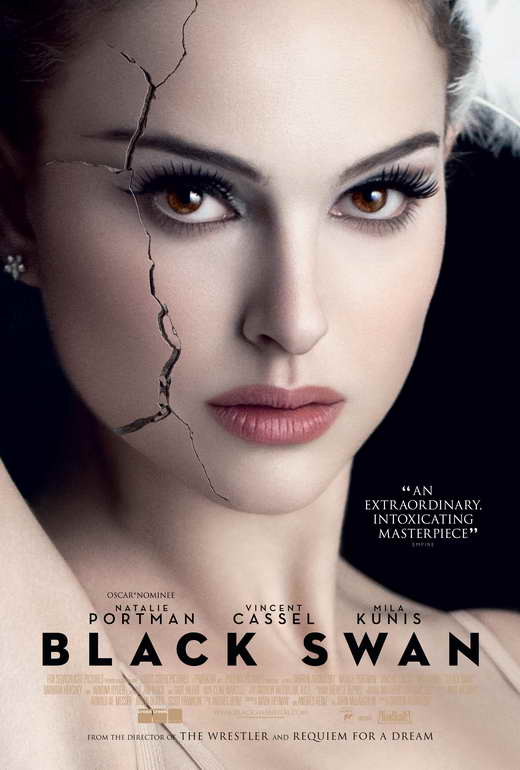
Black Swan: A Lesson in Broken Feminism

(Picture from MoviePosters.com)

ALERT: This movie features scenes that the main character hallucinates, which I reference; therefore, movie spoilers are present.

Time and time again Darren Aronofsky succeeds in producing films that I can’t watch twice. Try as I might, I just cannot rustle up the will to re-watch any of his movies. Pi bored me almost to tears, Hugh “wolverine forever” Jackman ruined The Fountain, and Requiem for a Dream, despite all of its brilliance, left me with such psychological scars that I cringe just passing it on the shelf at the movie store. Aronofsky’s latest film, Black Swan, continues the trend, though this time its ideological bias is what ultimately renders it best left as a one-time experience.

Which is too bad, because as a movie, it is really well done. I’m a sucker for films featuring mental illness and this one not only capture that angle well, but soared as high as I think Aronofsky’s vision for it would allow. The levels of psychology explored in the mind of the main character, Nina (Natalie Portman) are intriguing without being overblowingly psychotic. On the surface, the storyline is an obvious tragedy: a young woman goes insane while trying to prepare herself for (and ultimately achieving) the so-called “perfect” performance of her career. A technically gifted ballerina, she is given a role where she must embody two characters: the technically perfect and reserved White Swan, and the mysterious, dark, sensual, passionate Black Swan; a literal Jekyll and Hyde of the ballet world.

All this time, her understudy, a girl named Lily, is a “free spirit” who, while lacking technical discipline, embodies the black swan almost perfectly. Nina must then fight not only her own lack of confidence in forgetting all that she has trained for up until this moment (in order to capture the spirit of the black swan), but also the lingering feeling that she may soon be replaced. The key that allows her to finally harmonize that black/white dichotomy in her final performance is an endorphin high brought about by a self-inflicted stab wound to the abdomen - a true Phyrric victory if there ever was one.

Underneath this tragedy, however, feminist themes run strong. The movie draws out scenes that emphasize the degrees to which Nina must go to be perfect: grapefruit-and-egg-white diets (followed by bingeing), weight-watching, a mother who constantly fusses, daily stretching and exercises, early nights filled with restless sleep, and long make-up application sessions. She is a doll in a dollhouse, marched from room to room, from home to rehearsal to stage to back home. "This is not freedom," the film seems to scream, "This is not normal!" The message is conveyed primarily in the scenes in which Nina hallucinates: a hang-nail removal having drastic consequences, a toenail cracking to uselessness, webbed feet, legs bending at odd angles. Her body is falling apart right before her eyes despite all of her attempts at control. Again the message here is clear: This is not worth it and everything will probably not be ok.


(Picture from the official webpage of Black Swan)

If Nina’s control won’t get her to the top, then what will? The answer seeps into nearly every sceme - her sexuality. Black Swan is rife with nods to the third wave of feminism, the lie that full knowledge and experience of feminine sexuality is not only the swiss-army knife of the modern woman, but even that it is the key to ultimate self-realization. While the viewer is told that Nina has has some sexual experiences in the past, for the most part she comes off rather priggish, naive, and sexually self-repressed. Her creepy ballet troupe director believes that breaking that repression will ultimately allow her to embody the sensual black swan, and takes it upon himself to facilitate the transition. He forces himself on her twice, once with a kiss to find out if she is good for the part (she bites him, somehow proving that she is), and another time gropes her and calls it “seduction.” (“See how easy it was for me to seduce you? Now I need you to be able to do that on queue!,” is the “life lesson” there.) I was at once horrified and impressed with the brazen misuse of such a loaded feminine term.

Perhaps most controversial about the movie is that he assigns Nina the “homework” of going home and touching herself, as if “self-discovery” and orgasm apart from relationship is a integral component of well-rounded femininity. To turn some feminist lingo on itself for a moment, it almost seems that the goal is for Nina, as an “animus”, to be a sort of “celibate priest incarnating God as she plays the role of a creator” of the rest of her self. Yet as she writhes on her bed in private, on the screen she remains no more than an object of scopic consumption. There is no power there - only weakness. This preoccupation with her myopic sexual release culminates in a lesbian sex hallucination completely devoid of intimacy. Not only is the act itself over far to soon for any meaningful climax to have been achieved (contributing to the pornographic and therefore exploitive nature of the scene), but its ultimate result is that Nina, thanks to vendrous mental delusions, stole her sense of sexual liberation from her understudy (her fantastical partner) instead of searching it out on her own. But hey, whatever helps fulfill her dream role, right? Don’t let consistency get in the way.

Despite criticisms some leniency may be required - this is, after all, a story about mental illness brought upon by eating disorders and a high-stress lifestyle in a fragile girl. But wait, no. The options that those in authority give Nina as ways to achieve her ultimate goal are ludicrous. Barbie-doll physique? Manipulative authority figures? Selfish sexual empowerment? This kind of ideology is ultimately what makes Black Swan difficult, if not impossible, to watch twice. Even if Nina hadn’t been mentally ill, the pathways that lead to her success are ultimately vapid and devoid of any true character development. That doesn’t make for a rewarding viewing experience. I don’t want to be entertained by being lied to. It’s sad, because the movie was so well done, but this is yet another Aronofsky film that will become but a memory of my twenties.


_DZ submit to reddit

12.11.2010

"My Beautiful Dark Twisted Fantasy" or, Yes, Kanye is Insane

Since Kanye West’s latest album, My Beautiful Dark Twisted Fantasy “dropped” a few weeks back, people can’t stop talking about it. Rolling Stone and Pitchfork Media both gave it a perfect score, and the single “Runaway” has over two-and-a-half million views on YouTube. His 35-minute video that accompanies the album has (counting both clean and unedited versions) close to twelve million views. Ridiculous. I don’t even follow any hip-hop/rap releases, and not only did I hear about it, but I sat through the whole half-hour ordeal. Oh, and I watched the single eight times. Why does the press and the internet like this release so much? Heck, why do I like it so much? Of course, West is still a complete egotist - his music is still a reflection of that personality. Allmusic.com puts it well:
“In some ways, [this album is] the culmination of [his] first four albums, but it does not merely draw characteristics from each one of them. The 13 tracks, eight of which are between five and nine minutes in length, sometimes fuse them together simultaneously. Consequently, the sonic and emotional layers are often difficult to pry apart and enumerate.”
What was good about (I think, specifically) Graduation and 808s & Heartbreak, here coalesce to form a holistic view of West, a view only bolstered by his latest media shenanigans. Beautiful...Fantasy is just completely Kanye - these 13 tracks are what he is about, inside and out. It's raw and even embarrassing at times. When, on “Runaway,” he claims to have taken a picture of his genitalia and emailed it to a woman, you get the idea that, so long as the lyric is not a prophesy about a aging NFL quarterback, that it is something that Kanye has actually done. Sad, but that is who he is, so “runaway from me, baby. Runaway!,” he pleads. Pitchfork elaborates:
“[W]ithout his exploding self-worth-- itself a cyclical reaction to the self-doubt so much of his music explores-- there would be no Twisted Fantasy. "Every superhero needs his theme music," he says on "POWER", and though he's far from the virtuous paragons of comic book lore, he's no less complex. In his public life, he exhibits vulnerability and invincibility in equal measure, but he's just as apt at villainy-- especially here.”
Kanye knows that he is fallen and so has to prop himself up. He has to build something out of nothing. And see, I don’t think that that is lost on us. Yes, the tracks are well-crafted and the bass is thumping, but what makes the album so appealing is that Kanye is effectively starving himself to death on top of a pillar in the town square. It’s a spectacle, an aestheticization of his own destruction.
This idea, I have also argued, is why Lady Gaga is so attractive. Just as Gaga “left her head and her heart on the dancefloor,” so to is Kanye baring himself, multitude of flaws and all. And, let’s not forget, Gaga already acted out her own death in a music video. I wouldn’t be surprised if Kanye’s next move echoed those impulses.
It’s said that the best music is that which does not bore the listener, and as I listen to wider varieties of music, the more I find this to be, in fact, completely true. Many things can make music interesting: new sounds, new rhythms, quirky lyrics, etc, but I would argue that most important is the ability to show your personality through your music. David Bowie can change with the times and yet still be himself. Vernon Reid can smoooothly transition from a twenty-something shredder in neon tights to the anchor of a free-form jazz/rock hybrid collaboration. Lady Gaga is a wacked-out plastic disco antibarbie. Each transition inevitably shows in their music, and this is what keeps it interesting. Ultimately, Beautiful...Fantasy is a solid record because it is inseparable from Kanye himself, and this is precisely why we are attracted to it. We aren’t really listening to slick production and bi-polar lyrics; we’re listening to a functionally insane man make music. And functionally insane men are interesting to us.


_DZ submit to reddit

12.03.2010

Guest Post: Maria Rainier on Cultural Arrogance

This week's post comes from Maria Rainier who contacted me, like, a month ago, and offered to write a post. I'm pleased with how it turned out, even though it was a long time coming. Like me, Maria has experience living in Japan, and her views on cultural cross-pollination and adjustment, while unique, certainly resonate to some degree with my experience. That being said, her opinions are entirely her own and I welcome the diversity she brings to core::minimalist. I hope you enjoy her article, and feel free to give her link a click once you have reached the end!

_DZ

--------------------------------------
Around the World in a Little Over 80 Days and What I Learned About Cultural Arrogance

Until I arrived, America was my promised land. And then it all went to hell. People didn’t greet me with huge smiles when I entered convenience stores and they didn’t give me an exaggerated bow when I left (they also threw my change back at me instead of placing it in a little plastic tray and gently nudging it across the counter toward me). Nobody had any sense of personal space in concerts or bars. Nobody had any manners. My friends gave me funny looks when I gave themomiage, or gifts. Everyone told me to stop apologizing.
To a college-bound kid who grew up in Japan, America was a nightmare.
And then there were the questions. It’s not news to most kids who grow up abroad that when you go (or go back) to America, you get an interesting array of questions. Here are some—word for word—that I was asked:
Do you eat raw fish?
Do you live in teepees?
Is Japan that island off the coast of Africa or somewhere?
Do you guys have gnats? I hate gnats.
Is Hiroshima still in ruins?
I won’t go into the Hiroshima bit. I want to, but I won’t. Instead, I highly recommend a great book, Stephen Walker’s Shockwave: Countdown to Hiroshima. That’s all I’ll say on the matter.
Cultural Superiority: the American Way
What I will go into, however, is how appalled I was that when I offered a couple of American friends Japanese chocolate candies—and anyone who’s ever had Japanese candy knows that it’s phenomenal—they took one look at the foreign writing on it and said, “I don’t eat furren food.”
This would not be the last time I’d hear something to the effect of, “Why doesn’t the world do things theAmerican way?”
For a few years, I went through an I-hate-American-and-I-can’t-wait-to-graduate phase for this very reason. I found the Americans around me to be self-righteous, self-important, and self-serving. If it wasn’t in English and if it didn’t praise the Lawd or Amurrica (as the two are synonymous to many Americans I know), it was trash.
Cultural Superiority: Not Just the American Way
In 2007, I studied abroad in Europe. My home-stay family lived in northern Italy, where locals spoke more German than Italian. I found that if I spoke Italian to the town baker or gelato man, I got dirty looks. These looks, however, were nothing in comparison to the derision on the faces of Romans to whom I accidentally spoke German. German was the “lesser” language, while Italian was the language of the oppressors.
Similarly, when I visited my family in Japan that same year, I found that if there was a Mandarin-speaking person in a Japanese town, the usually humble and open-minded Japanese turned up their noses and protected their purses. Koreans and southeastern Asians had the same effect on many Japanese I saw.
Not too long ago, a Chinese trawler bumped into a Japanese patrol boat around what the Japanese call the Ryukyu Islands, which they boldly deemed their territory and therefore held the Chinese captain and crew hostage for days before returning them to their country. The history between these countries can’t be discounted—before WWII, Japan defeated Russia, China, and Korea, and the Imperial Army’s conduct there was less than reputable. Post-WWII turf wars aside, China and Japan haven’t been buddy-buddy on anything: China keeps kidnapping Japanese citizens and putting lead in their toothpaste, and many Japanese refuse to admit to the Nanking atrocity. That many Japanese citizens hold deep grudges and prejudices against the Chinese and feel a sense of cultural superiority over them is no exaggeration.
This sounds oddly familiar. Since the colonists’ defeat of the English oh-so-very-long-ago, many Americans can’t stop poking fun at the Brits and Europeans (and the latter can only laugh at American antics). Meanwhile, North American treatment of Latin Americans is beyond abysmal. That racial epithets—most of which I didn’t even know existed before I came to America—can be so blithely dropped in everyday conversation is a point in itself.
The Kamikaze Incident
Bigotry is alive and well, not that it’s news. In September of this year, an American military base employee in Japan ran over an elderly Japanese man going home from his garden plot across the road. He died three hours later. He also happened to be the vice chairman of the anti-base housing coalition, which happened to be having a very important meeting that day with a prominent Japanese official to prevent the nearby military base’s planned expansion. Local Japanese often fall victim to military personnel’s drunken driving and prejudices, ear-splitting and low-flying jets, and the humiliation of living under the thumb of the country that dropped not one but two atomic bombs on them over sixty years ago.
On that base, whispers quickly abounded among American military and civilians: Did he do it on purpose?
What for, how, and why, I might ask?
You know, they used to be kamikaze. . . .
Oh, right. That hugely misunderstood band of brothers who were forced or brain-washed into dying for their lying government and Emperor because if they didn’t, their families would be punished and they’d be sent to a deadly war in the Southeast, anyway. That thing that no one in Japan talks about anymore because it’s ludicrous and horrifying even to them. That thing that’s been falsely linked by the ever-so-fair-and-balanced Fox News to the 9/11 terrorists when in fact the kamikaze never once targeted civilians in a non-combat situation. Oh, yeah. That thing.
But I Don’t Mean to be a Killjoy
Yeah, American prejudices and examples of cultural superiority annoy me more than anyone else’s, I think. That’s my own bigotry. Bigotry is alive and well. Again, it’s not news. You don’t have to look far for it, either. I found it around the world.
The good news in all this? That there are sane people around the world, too, whose kindness knows few, if any, culturally implemented bounds. It was an American who let me cut thirty people in the security line at the Kansai International Airport when I had five minutes before my plane took off. It was a Japanese man that let me charge my camera battery and warm my frosted hands in his sake store in Iwakuni. It was a My Lai massacre survivor who hugged me when I told her that my mother was a Hiroshima victim. It was in Grand Cayman that locals and Americans worked together to shelter and feed abused and stray animals on the island. These are the truths that let me sleep at night.


Bio: Maria Rainier is a freelance writer and blog junkie. She is currently a resident blogger at First in Education, researching various online programs and blogging about student life issues. In her spare time, she enjoys square-foot gardening, swimming, and avoiding her laptop.

10.08.2010

Guest Post : Angelita Williams on The Russian Experience

This is my first unsolicited guest post, which is rather exciting. Even more exciting is that Angelita's article is coming from a part of the world that I have never been to nor know much about. (She also cites The Paradox of Choice, which is one of my favorite books and definitely recommended reading.) She was great to work with, and very gracious as I was super busy and often late in getting back to her. That being said, I'm glad how this turned out: I really enjoyed her essay and I hope you will, too. I am still very open to guest writers, and if you think you have a story and experience to share, please email me and we can get working on fleshing out your ideas to the fullest potential!

---------------------------

The Russian Experience: How My Time Abroad Changed My Perspective
When I was an undergraduate student a few years ago, I decided to take a semester to study in Russia. I had been studying the Russian language for a few years, and so I figured I should put my knowledge to some good use. However, what I didn't bank on was how much it would change my perspective on several different things, not least of which was my relationship to consumer goods.
It would be trite to say that America is a consumerist society mired in the acquisition of material goods. And whenever anyone said something to that effect, I always thought it was more of a stereotype than anything. However, when I went to Russia, I realized that there was more truth to the stereotype than I had ever imagined.
One difference that I encountered was the fact that no one kept tabs on anything. The Russian students I hung out with were very serious about sharing. When I was in college in America, there was always talk of "I got you the other day, now you owe me X." Not only did this notion of debt not surface among my friends, but whenever I told a Russian friend, "Hey, I owe you a meal; thanks for helping me out with this or that," he or she was not only dismissive, but actually confused. "What do you mean?" they would say. "I did it because you're my friend; you don't owe me anything." This idea that everyone has a share in everything, that when it comes to things ownership is irrelevant, is even reflecting in the language. "My" is often omitted in phrases like "I lost my key," and when you say "I have an X", the literal translation is "I am next to an X".
Another distinction between Russian and American students that I noticed was a profound respect for both the arts and sciences. Where I studied in America, if someone was studying hard sciences, he or she knew or cared little about things like literature, art, etc., while if you were a humanities student you didn't dabble in mathematics or physics. In other words, knowledge in America is considered to be black and white. You're either interested in one side of it or another. Most of the Russian students I met, however, drew inspiration from various fields, even if they were focusing on one in school.
One of the most refreshing differences I encountered was the fact that there was far less choice in terms of brands and products. Trips to the grocery store were simplified ten-fold simply because I wasn't being inundated by millions of different varieties of the same exact product. Of course, there were a few varieties, but not nearly as many as I was accustomed to in America. When I returned home, I had become so used to the simplicity that I found it frustrating to even step into a superstore such as we have. This reminded me of a recent book I read called "The Paradox of Choice". It was not until I experienced the alternative in Russia, that I saw author Barry Schwartz's theory--that too much consumer choice actually can cause anxiety and inhibit our ability to choose--in action.
This is not to say, however, that Russia doesn't have its fair share of problems, or that its culture is perfect or even preferable to American culture. However, it was a truly eye-opening experience in that it made me see my own way of living in a different light. What's more, spending six months in Russia also did much to dismantle the popular image I had of Russians as cold, suspicious people. And I think it's precisely this destruction of stereotypes that makes living in a different place so valuable an experience. If you have the chance, I think everyone should spend time abroad, no matter where you go.


This guest post is contributed by Angelita Williams. She welcomes your comments at her email Id: angelita.williams7 @gmail.com.


_DZ

10.05.2010

On Cultivation Of Musical Tastes Via Old-School Serendipity

One thing my resolution of not buying music for a year has taught me is that music is more than a commodity. It is more than something to be bought, consumed, and collected. Huge digital music libraries, in this day and age, don’t say much about their owners. Yet we continue to define ourselves by what style or artists we listen to. I think this is misguided - personal musical taste, rather than the musical collection, should be the object of curation.

This is somewhat paradoxical, because the primary way we expand and refine our taste is through acquiring new music. We buy new albums, give them a few spins, and, if we like them, keep them. If we don’t like them, we still keep them because A) the album was an investment and we don’t want to suffer the loss of getting rid of it, or B) the music has been ripped on our computer, and it now pads our iTunes song count. The ultimate end result of both reasons is that we accumulate music we don’t necessarily want. I’m dealing with this right now - I have a couple albums I impulsively purchased from Amazon MP3 at the end of last year, and now I never listen to them. I don’t want to delete them because that would effectively mean I lost $10. What should I do?

I don’t have this problem when I buy used CDs. If I buy a CD and end up not liking it, I give it away to a friend who may like it. If I have no interesting interested friends, I just take it to Goodwill; somebody else may enjoy it, and the money goes to support a good cause. I’ve gotten rid of scores of CDs this way. It’s great. Music on physical media is easy for me to get rid of. But could it be easier? What would be the easiest, most cost effective, legal way to discover new music? Let’s look at where the current options are lacking.

The obvious answer is bittorrent, but that is illegal. Internet radio stations like Pandora or Last.fm, or sweet sites like YouTube Disco, are legal, but they’re not very mobile yet. (You know, for the 95% of the market that the iPhone hasn’t penetrated.) And if you do hear something you like on those services, you still have to go out and buy an album. Besides, the key word in play is discovering new music. There is, almost by definition, a huge serendipity quotient here. This is not music that Amazon, iTunes, or Last.fm recommends to you. This is not borrowing a friend’s CD to give it a listen. This is music you may/would never have sought out on your own. This is browsing the “recent arrival” racks at your local record store.

But browsing racks takes a lot of time. You have to stand there and flip for the better part of half an hour. Also, you don’t know if you’re going to get something good; what if the CD is scratched? There are other downsides: record-store CDs are not (relatively) cheap. Most discs are near the $7 mark - a lot to spend on a album you’re not sure you’ll like. And if you don’t like it, you again have to deal with how or if you’ll get rid of it - kind of mentally taxing for what is supposed to be serendipitous.


So it’s clear we need a music format that is:

*Mobile

*Home to a wide range of music

*Cheaper than $7

*Widely available

*Practically disposable, so that there is no separation anxiety if the album is crap


What am I talking about here?

I'm talking about the audio cassette tape, which neatly fits all of the required categories: You can stick them in a Walkman (which never skips!), you can find every type of music on them, you can buy them at any thrift store in the country for pennies, and because of that you feel no guilt about throwing them away should you not fancy whatever you bought. As the saying goes, it’s a win-win(-win).

Cassettes are so cheap that it is no problem to wolf them down, glean any nutritious value from their music, refine your musical tastes accordingly, and toss them. If you like the music, keep the cassette until it wears out, and then legally download it. That’s the great thing about digital music - you can get practically any music from any time period. You don’t have to waste time tracking down another copy of your favorite cassette.

I love cassettes. A few years back I was driving a borrowed Nissan that only had a cassette player. I went to the local Salvation Army and bought three tapes for like a dollar: David Bowie’s Black Tie White Noise, Nirvana’s Bleach, and Primus’ Pork Soda. Those tapes got really heavy rotation because they were all I listened to when I was driving. The Bowie album was awesome; the other two pretty much sucked. So I bought the Bowie record on CD and the others were lost when the car was totaled and towed.

Experiencing music this way was so easy yet so practical. Musical taste: Refined! Cost? Minimized!

A year later I had my own place and kept a tape player in the kitchen. I spent a lot of time in there and consequently was heavily exposed to the only two tapes I had at the time: Living Colour’s Vivid and Poison’s Look What The Cat Dragged In! Hard rock albums on cassette is a glorious thing. For a reason that I have yet to discern, I took the tape player to Goodwill when I moved. I still don’t know what on earth I was thinking. I recently was given some more cassettes (Public Enemy, Frank Zappa (!!), Smashing Pumpkins, Cream) and now I have no player to play them on. Sigh.

Some might raise the objection that I’m being sentimental. If I was being sentimental, I’d advocate records, which, oops, I already did like two years ago. Records are great for establishing a music collection, not for trying new music out. Try the cassette out, then, if you like it, buy the record. The cassette even mirrors the double-sidedness of a record! Seems perfectly acceptable to me!

Another objection might be in your minds: But cassette’s are only available for old music!

So? The object here is to refine musical taste cheaply. Was there no good music available on cassette? Or have you heard it all? Yes, cassettes are old. So is Hysteria, Aja, London Calling, My Life in the Bush of Ghosts, Layla and Other Assorted Love Songs, and like a bajillion other albums that weren’t released in the last twenty years. If you’re going to be that elitist, feel free to stick with the Popular Songs Right This Second list on the iTunes Store.

I really do believe that cassettes are the best way to develop a great taste in music - they are the cheapest, easiest way to expose yourself to any and every artist and style of music. It excludes new releases, but who cares? If I want new releases, I can go to Amazon, Ping, iLike, or one of the other dozens of services who want to define my musical taste for me. With cassette tapes, I’m being exposed to music history serendipitously. And much of the music that makes up music history is really, really good. Cassettes deliver that to me. But even if they don’t, that’s OK - in the same motion I can toss it into the trash and pop something else in the Walkman. (As soon as I get one!)


Dann writes from his home in Minnesota, which can be rearranged to spell "Aeon Mints," which, you gotta admit, is a pretty great name for a band.


_DZ submit to reddit

9.11.2010

Guest Post: Daniel Gateley from DeeplyInexplicable.com!

I haven't been able to get any decent writing done lately, so I thought I would take the opportunity to introduce you to my friend Daniel who writes a literature and entertainment review blog. We were classmates in Tokyo and have been friends since back in the day when Xangas were cool. He knows more about American literature than I ever will, and I'm honored that he agreed to write a guest post for me! I really like where's he's coming from in this article because I think we were in the same boat after high school. I also took a year off, but the only difference was that he was traveling in exotic Europe while I was living at home with my parents. His takes on life are witty and thoughtful and almost always infused with the wistful longings of a boy hopelessly in love with Emily Dickinson. I hope you enjoy!
----

The 20-Somethings

Lately, I've been hearing and reading a lot about 20-somethings. I'm 24, myself, and it's been extremely interesting to read some of the research being done on my age bracket. Most of the findings suggest that, as generations go, mine is taking much longer than usual to settle into normal, stable adult lives. I can identify with that.

When I graduated from high school, I postponed college for a year and backpacked through Europe instead. It was an incredible year - one that I wouldn't trade for anything - but looking back, I have a better idea of the reasoning that went into making that choice. Doubt played a big part in causing the prospect of impending adulthood to loom large in my thoughts. I remember how I felt the day after graduation: abandoned. In those days I was in the habit of turning my thoughts into poems; in one of them, I described (rather dramatically) being set adrift on an ocean, alone. On a sub-conscious level, graduation was a lot more like a death-sentence than an emancipation. Heading off to Europe was a way to push off the inevitable, spend an expectation-free year abroad, and hopefully, return better prepared. I didn't go alone either; two of my classmates joined me in a temporary escape from our formless future.

The New York Times recently ran an article on the 20-something phenomenon which had some pretty big numbers:

"One-third of people in their 20s move to a new residence every year. Forty percent move back home with their parents at least once. They go through an average of seven jobs in their 20s, more job changes than in any other stretch. Two-thirds spend at least some time living with a romantic partner without being married. And marriage occurs later than ever. The median age at first marriage in the early 1970s, when the baby boomers were young, was 21 for women and 23 for men; by 2009 it had climbed to 26 for women and 28 for men, five years in a little more than a generation."
The numbers only confirm what I've been observing the last few years. More and more, my generation is undergoing a pretty unique state of being. Most of my friends, the people I hang out with, talk to on a regular basis, identify with - they don't have steady jobs that they can expect to keep for years to come, or want to, despite already being old enough to have careers. Almost all of them are unmarried, and a surprisingly large number don't even date. Few of them have finished school. They all live from paycheck to paycheck, barely getting by on what they make.

It's tragic that the small number of people I've known who have successfully taken on some of the "adult" responsibilities that elude the rest of us have become irretrievably distant and cut-off - my first room-mate from college is just one example. When he got engaged, about a year after we started living together, everything changed very quickly. Only a few months later, he was married, had a new car, had graduated and gotten a lucrative full-time job in another state. Less than a year after that, he was a father. We don't talk or see each other much anymore. When he isn't working, he's spending time with his brand-new family, and when he's not doing that, he's spending time with couples, or co-workers - people he has a lot more in common with than I do. I'm happy for him, but I kinda miss him. Also, when I think of him, I feel a little bit guilty. "Why don't I have a job, or a girlfriend, for that matter?" I ask myself. "How come I'm not responsible like that?"

Why is this happening, and how long will it last? What effect will it have? Nobody seems to have any answers. There is a psychologist who's making a case for "emerging adulthood" as a new and previously nonexistent developmental phase, but his position seems to be an unpopular one, or at least a problematic one for most psychologists. Financially, no one is sure what effect the postponing of marriage and entering the workforce will have in the long term.

Maybe the most significant epiphany we can have as a result of all this is that our parents can't explain, fully sympathize with, or do anything about the difficulties we have to deal with. The world is, quite simply, a changing place, and changing faster all the time. If anyone is going to sort out this new world, it's got to be us. It may not be fair to have to start from scratch, so to speak, but we can do it. We ARE adults, even if we don't have some of the same responsibilities that our parents did at our age.


Daniel Gateley keeps a blog at DeeplyInexplicable.com


_DZ submit to reddit

8.16.2010

Everett Bogue and the New Minimalism

A notable snobby bicycle blogger recently alerted me to the existence of celebrity minimalist blogger Everett Bogue and his blog Far Beyond The Stars. Everett is apparently a minimalist guru of sorts who quit his writing job in New York and moved to Oakland to take up a “location-independent” lifestyle with his girlfriend. He is the author of two best-selling e-books (a position that, like “employee of the month”, is a great way to be a winner and a loser at the same time) and proves eager to share about how he lives on the income of working only two hours a day. This ten-hour workweek is a bit more than Tim Ferriss’ four-hour workweek but Tim has a bit more stuff than Everett does, thus canceling out any perceived advantage. (Everett actually admits that no work can be 100% original these days, and is no doubt heavily influenced my Ferriss, Seth Godin, and other work-better-not-longer gurus.) Despite this two-hour workday, however, Mr Bogue has recently admitted that he needs a vacation and will go camping to get away from the electronic hive that makes his lifestyle feasible. It’s a tough life when you need to rearrange your schedule to fill two more hours of the day with recreation.

Snide remarks aside, after reading a few of Everett’s posts I realized he does have some things going for him. He is quite skilled in writing propaganda, motivating readers with such lines as

- “The idea is that we need to curb our consumerism in order to focus on the important. This is why I live with less, because I’ve decided to stop consuming and start living.”

- “You need to write down an unrealistic goal and start to live and breathe it every single day. This can be simple, or more complex. Make it crazy though! The sky is the limit, and trust me, people have been up there too.”

- “The time to start your own very small business is now, as there have never been more opportunities to reach out and find the tribe that will support your goals.”


Using words to stir emotions is a powerful skill; one I think should be taught in schools. In light of Lenin’s teaching that the line between education and propaganda is subjective and reflects educator’s confidence in the student’s ability to learn, Everett has no problem playing the role of shepherd to his flock of commenters, offering advice on everything from small business entrepreneurship to selecting social circles. He is an enthusiast of lists; indeed, his “e-book” is tantamount to a list of bullet points with short elaborative paragraphs. These lists are a handy way of organizing more information than a reader can handle on the first read, thus ensuring a sense of information overload that will cause the reader to keep the book close at virtual hand for quick reference should they find they don’t remember Point 34. Maybe they won’t even be looking for enlightening texts, as the book is also illustrated with “peaceful photographs from [Everett’s] travels.”

But let’s shluff this rather superficial criticism aside and actually analyze some of what Everett claims to be about - let’s see what walk he is walking.


He claims to be “location-independent”

This is really just a fancy way of saying that you have no roots. It may be hard for white-collar people to swallow, but being location-independent is actually a default human state rather than a progressive one- a state that ancient Mesopotamian people lived in for hundreds of years. The idea of people settling down together to foster the basics of a community - things like commercial trade, cultural growth, division of land, organized defense, etc - is actually a pretty civilized notion. Being “location-independent” just means you’re rejecting permanent community, and the English language has, in fact, several words for such people who have no home base: nomad, vagrant, drifter, fugitive, itinerant, and refugee come to mind. And living as a celebrity blogger certainly isn’t the only occupation that allows comfortable itinerancy - be a half-decent bartender or car salesman and you can get work anywhere.


He counts how many things he lives with

It used to be 100, then he cut it to 75, then 50, and now he’s up to 57. He originally intended to cut possessions down so that he could spend less time worrying about taking care of all the stuff he owned, but if he’s still doing regular inventory counts, chances are he’s still kind of worried about his stuff, albeit now out of different motives. I applaud his cuts - I think that living with less stuff is good - but I am wary about the quantification of the minimalist ethos. We humans love comparing ourselves to one another, and using numbers is a really easy way to do that. Is Everett with 57 things doing a “better job” than someone with 62? He lives in Oakland, with a mild climate. What about me in Minnesota, where I need at least two distinct seasons of clothing? Having to own winter boots, hats, mittens, snow pants, etc, just adds to my stuff count, putting me at a disadvantage. The numbers quickly become meaningless, so why bother with them at all?


He lives life with no direction

A direct quote from his blog:

“...I don’t really have a routine, I simply wake up every morning and do what I feel inspired to do from start to finish.”

This is worthless to anyone looking for concrete advice. Routinizing the mundane tasks of life allows you to turn your brain off and not worry about them, freeing it instead to focus on what you want to think about. If you want to work for only two hours a day, as he advocates, there must be some routine that you can follow in order to get anything done. Even something as basic as - wake up, breakfast, newspaper, read for 30 min, check email, work - can form a simple trellis around which you can weave your life. Spontaneity and daydreaming are important, but the entropy of the universe ensures that repetitive tasks are a part of daily life. We just have to organize those tasks so well that we don’t have to think about them. Everett abhors routine yet automates his blog as much as possible, so he at least gets the irony vote.


He wants to also be your financial guru

Everett is also the author of the e-book Minimalist Business, a (virtual) tome offering tips on how to get the most money out of your work time. Advice also includes how to quit your job successfully and follow your dreams, since, obviously, there is no way that your current job is part of your dream. Apparently downshifting your lifestyle, reducing expenses and eliminating possessions means earning less money as well. One wonders why you can’t keep making $40,000 a year and just buy less stuff. Sure you have extra money, but can’t you give that away to the homeless or to your church or some other charitable organization? Why can’t you use extra income to enable others rather than minimize your income and support only yourself?


You can check out the blog for yourself and make your own decisions but, to me, Mr. Bogue just sounds like another aspiring self-help writer. Everything is focused on you, the reader and consumer of his advice. You can follow your dreams. You can live the life that you always wanted to. You can be an outlier from society and make your life into a model for others. You can earn the respect of others by being semi-ascetic and respecting yourself first. Be centered and your life will fall into place around you! It really isn’t anything we haven’t heard before. Sure, try and live on less stuff. But don’t let how much stuff you live without define you anymore than how much stuff you live with. You’re not your job, or lack thereof. You’re not your 100 things, or 62, or 33. You’re not your location or state of permanence. You’re who God made you to be, doing what He wants you to do.


_DZ submit to reddit