Showing posts with label movie. Show all posts

1.10.2011

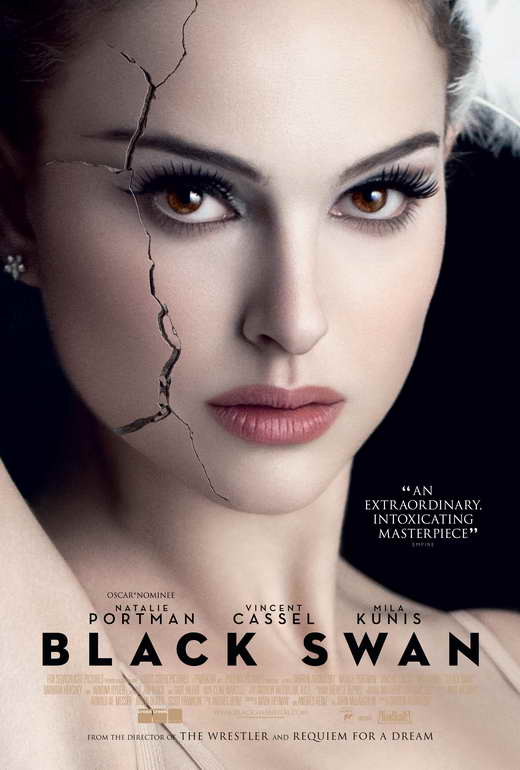
Black Swan: A Lesson in Broken Feminism

(Picture from MoviePosters.com)

ALERT: This movie features scenes that the main character hallucinates, which I reference; therefore, movie spoilers are present.

Time and time again Darren Aronofsky succeeds in producing films that I can’t watch twice. Try as I might, I just cannot rustle up the will to re-watch any of his movies. Pi bored me almost to tears, Hugh “wolverine forever” Jackman ruined The Fountain, and Requiem for a Dream, despite all of its brilliance, left me with such psychological scars that I cringe just passing it on the shelf at the movie store. Aronofsky’s latest film, Black Swan, continues the trend, though this time its ideological bias is what ultimately renders it best left as a one-time experience.

Which is too bad, because as a movie, it is really well done. I’m a sucker for films featuring mental illness and this one not only capture that angle well, but soared as high as I think Aronofsky’s vision for it would allow. The levels of psychology explored in the mind of the main character, Nina (Natalie Portman) are intriguing without being overblowingly psychotic. On the surface, the storyline is an obvious tragedy: a young woman goes insane while trying to prepare herself for (and ultimately achieving) the so-called “perfect” performance of her career. A technically gifted ballerina, she is given a role where she must embody two characters: the technically perfect and reserved White Swan, and the mysterious, dark, sensual, passionate Black Swan; a literal Jekyll and Hyde of the ballet world.

All this time, her understudy, a girl named Lily, is a “free spirit” who, while lacking technical discipline, embodies the black swan almost perfectly. Nina must then fight not only her own lack of confidence in forgetting all that she has trained for up until this moment (in order to capture the spirit of the black swan), but also the lingering feeling that she may soon be replaced. The key that allows her to finally harmonize that black/white dichotomy in her final performance is an endorphin high brought about by a self-inflicted stab wound to the abdomen - a true Phyrric victory if there ever was one.

Underneath this tragedy, however, feminist themes run strong. The movie draws out scenes that emphasize the degrees to which Nina must go to be perfect: grapefruit-and-egg-white diets (followed by bingeing), weight-watching, a mother who constantly fusses, daily stretching and exercises, early nights filled with restless sleep, and long make-up application sessions. She is a doll in a dollhouse, marched from room to room, from home to rehearsal to stage to back home. "This is not freedom," the film seems to scream, "This is not normal!" The message is conveyed primarily in the scenes in which Nina hallucinates: a hang-nail removal having drastic consequences, a toenail cracking to uselessness, webbed feet, legs bending at odd angles. Her body is falling apart right before her eyes despite all of her attempts at control. Again the message here is clear: This is not worth it and everything will probably not be ok.


(Picture from the official webpage of Black Swan)

If Nina’s control won’t get her to the top, then what will? The answer seeps into nearly every sceme - her sexuality. Black Swan is rife with nods to the third wave of feminism, the lie that full knowledge and experience of feminine sexuality is not only the swiss-army knife of the modern woman, but even that it is the key to ultimate self-realization. While the viewer is told that Nina has has some sexual experiences in the past, for the most part she comes off rather priggish, naive, and sexually self-repressed. Her creepy ballet troupe director believes that breaking that repression will ultimately allow her to embody the sensual black swan, and takes it upon himself to facilitate the transition. He forces himself on her twice, once with a kiss to find out if she is good for the part (she bites him, somehow proving that she is), and another time gropes her and calls it “seduction.” (“See how easy it was for me to seduce you? Now I need you to be able to do that on queue!,” is the “life lesson” there.) I was at once horrified and impressed with the brazen misuse of such a loaded feminine term.

Perhaps most controversial about the movie is that he assigns Nina the “homework” of going home and touching herself, as if “self-discovery” and orgasm apart from relationship is a integral component of well-rounded femininity. To turn some feminist lingo on itself for a moment, it almost seems that the goal is for Nina, as an “animus”, to be a sort of “celibate priest incarnating God as she plays the role of a creator” of the rest of her self. Yet as she writhes on her bed in private, on the screen she remains no more than an object of scopic consumption. There is no power there - only weakness. This preoccupation with her myopic sexual release culminates in a lesbian sex hallucination completely devoid of intimacy. Not only is the act itself over far to soon for any meaningful climax to have been achieved (contributing to the pornographic and therefore exploitive nature of the scene), but its ultimate result is that Nina, thanks to vendrous mental delusions, stole her sense of sexual liberation from her understudy (her fantastical partner) instead of searching it out on her own. But hey, whatever helps fulfill her dream role, right? Don’t let consistency get in the way.

Despite criticisms some leniency may be required - this is, after all, a story about mental illness brought upon by eating disorders and a high-stress lifestyle in a fragile girl. But wait, no. The options that those in authority give Nina as ways to achieve her ultimate goal are ludicrous. Barbie-doll physique? Manipulative authority figures? Selfish sexual empowerment? This kind of ideology is ultimately what makes Black Swan difficult, if not impossible, to watch twice. Even if Nina hadn’t been mentally ill, the pathways that lead to her success are ultimately vapid and devoid of any true character development. That doesn’t make for a rewarding viewing experience. I don’t want to be entertained by being lied to. It’s sad, because the movie was so well done, but this is yet another Aronofsky film that will become but a memory of my twenties.


_DZ submit to reddit

11.03.2009

Apparently They Make Color-Safe Bleach

I stumbled across the YouTube trailer for the movie Juno the other day, and had forgotten some of the pure gem lines that that movie has. The trailer can be seen here.

Mark: Why do people think yellow is gender-neutral? I don’t know one man with a yellow bedroom.
---
Vanessa: Well, Juno, your parents must be wondering where you are. You might want to head home.
Juno: Nah. I'm already pregnant, so they figure nothing worse could happen to me.
---
Juno: Your shorts are looking especially gold today.
Bleeker: My mom uses color-safe bleach.

Truly, this is better living through chemistry.

_DZ


submit to reddit

6.02.2009

How I Relate to Movies And Why I Watch Them

I watched a movie called Blue Velvet the other night. Before that, I watched The Fountain. And, sometime this week, it is likely that I will watch both Cool Hand Luke and Intacto. All this movie watching is admittedly unlike me, for I rarely watch movies these days. Lately, though, I’ve been thinking a lot about that - “that” being why I do or do not watch movies. To me, watching movies is a form of cultural study; a medium through which I can forge links to friends and society in general.

I don’t relate to people or life through movies. I imagine that this has more to do with me not watching a lot of TV/movies as a kid and less to do with some lack of cognitive functioning, but I could be wrong. I’ll try to explain. When I watch a movie, I do so either because A) Friends/family/other people are watching it or B) So that I can have knowledge of what others are talking about or referring to or, in the rare case of C) I am re-watching a movie that I enjoy.

I treat movies as a sort of social capital, a way of furthering myself socially through acquisition of shared experience. I don’t really watch movies to think about how the story affects or mirrors my life or how it is a symbol of some relationship present in society or whether or not it was made to make a political statement. I don’t care. I watch a movie to get the plot and the main ideas, and to get an idea of whether I like it or not. I watch movies so that when someone say, “Hey did you see that wicked awesome scene in so-and-so?”, I can reply with “Yeah, but I thought it was too much like the scene in blanky-blank.” I watch movies to talk about them.

The funny thing is that I can trace back to the exact point in my life when I started doing this. It was April 17th, Monday, I was in seventh grade, and I had just watched Raiders of the Lost Ark the weekend before. I thought it was a good movie and was all excited to tell people about it, so at school that day, I went up to a kid named Bob, who I thought was pretty cool, and said, “Hey, I saw Raiders of the Lost Ark the other day. Have you seen it?”

“Pssh, YES,” he scoffed in an eight-grade-cool, almost as if he were offended that I had even entertained the thought that he had not seen it.

“OK, cool,” I said, and that was the end of the conversation.

But that stuck with me. That five second conversation taught me, however inaccurately, that every cool American kid had seen way more movies than I had, and I needed to get on the ball. I needed to play a lot of catch-up if I wanted to be cool, and man, did I ever want to be cool. I clearly needed to watch more movies, and since I didn’t have any precedent for the movie-watching experience, I made up my own. I became comfortable with watching movies alone. After all, I needed to catch up, right? And I couldn’t afford to wait for social situations where I could watch movies with others; I needed to watch them as fast as I could.

I began with renting VHS tapes from my local library. Or, more specifically, watching VHS tapes at the library audio-visual booths. See, Japan is really lax on media regulations, which meant that I, as a twelve-year-old, could rent R-rated American movies (in English, with JP subtitles) from the library as often as I wanted to. I did this relatively often, and the movies were, indeed, usually rated R - partly because general consensus among my peers was that all the “good” movies were R, and partly because I felt that watching any R-rated movie made me socially superior to any of my peers who watched PG-13 ones. This strategy, however, didn’t really work because I didn’t have the social connections to know which movies were “hot” and which ones were “not”, resulting, for the most part, in my watching all of the wrong ones. The cool kids watched MI:2 and Adam Sandler movies; I watched Cocoon and Robocop.

This continued until the 9th grade, when my family subscribed to cable Internet and I discovered P2P filesharing. Suddenly the whole Web was open to me, and I became a downloading fiend. Remember, though, that this was still 2001 and video encoding wasn’t the best. Even when it was, it took so long to download a 1GB+ file through 2001-era networks that P2P usually wasn’t worth it, so most of the movies I watched were either low-quality rips or in-theater camcorder captures (usually one and the same). It wasn’t pretty, but it got the job done - I was still educating myself. The (relative) respectability of the movies improved, too. Now I was watching Fast and Furious, Gladiator, Minority Report, Bourne Identity, and Rat Race (ironically, mostly PG-13 stuff). My family also got cable TV in the Internet bundle, so between the two media I should have been guaranteed social popularity and acceptance.

Hah! like that was going to happen. It turns out that just watching the same stuff as the cool kids do doesn’t make you cool, but I was to learn that a bit later in life. But I need to get back on track, because this essay is about my movie watching, not about how cool I wasn’t.

All this solitary movie watching has been helpful, though, in the sense that, because I didn’t have other peoples’ input during the movie, I was able to form my own honest opinion of it. These opinions, compounded throughout the years, have made me really critical of movies in general. Nowadays I find that very few movies are worth my time, and hence I am less swayed by a group decision to watch a movie I know I don’t like or know I will not like. This is a complete 180 from where I started as a tweener. I now watch movies for my own betterment; not to go with the group and lubricate social niceties. I rate and judge movies based on my own system, which I have distilled into the following four categories.

Movies Not Worth Watching - These movies were a waste of my time, and I would not recommend watching them to anyone that I like. Examples include Reign Of Fire, almost every Adam Sandler movie, Dolemite, The Ladykillers, I am Legend, Hancock, Wolverine, and Equilibrium.

Movies Worth Watching - These are movies that I felt had a good plot/elements/premise, and, even if I didn’t necessarily like said movies, would recommend that others watch them. They were worth watching once through. Examples would be Man on Fire, The Strangers, Wall-E, Ironman, Saw, and Windtalkers.

Movies I Liked - These are movies I enjoyed but can’t bring myself to buy on DVD because I don’t think I will re-watch them enough times. Examples include the LOTR trilogy, Dark Knight, American Gangster, Saving Private Ryan, The Matrix, and Blow.

Movies I Will Buy - An incredibly small number of movies fit into this category. I (effectively) never buy movies that I have not seen, and even then I have to like the movie a lot and be willing to watch it over and over again. This allows me to have a very intimate collection, because if I own movie that means, almost by definition, I have seen it at least three or four times. At this writing I own about 15 movies including Silence of the Lambs, Army of Darkness, Fight Club, Dead Poets Society, Big Fish, Super Troopers, and Zoolander.

I saw Raiders... when I was twelve, and my movie watching was never the same afterwards. Now, nine years and hundreds of movies later, I still watch movies to increase my social capital. I don’t watch them nearly as often or with as much social significance attached, but I still watch a majority of them alone. Maybe I need to stop that and get a life. Maybe I need to cut back and treat movies more as a social activity. Maybe I’m just fine the way I am. But if you ever want to watch a movie with me, you can ask, but please don’t be offended if I refuse to watch it.

I have my reasons.


_DZ


submit to reddit

5.11.2009

Jitensha - The Movie

Jitensha Movie

My good friend Yu Shibuya writes poems, short stories, and screenplays, and one of them has been turned into a movie! It should be awesome! Check it out!


_DZ


submit to reddit