Showing posts with label culture. Show all posts

12.11.2010

"My Beautiful Dark Twisted Fantasy" or, Yes, Kanye is Insane

Since Kanye West’s latest album, My Beautiful Dark Twisted Fantasy “dropped” a few weeks back, people can’t stop talking about it. Rolling Stone and Pitchfork Media both gave it a perfect score, and the single “Runaway” has over two-and-a-half million views on YouTube. His 35-minute video that accompanies the album has (counting both clean and unedited versions) close to twelve million views. Ridiculous. I don’t even follow any hip-hop/rap releases, and not only did I hear about it, but I sat through the whole half-hour ordeal. Oh, and I watched the single eight times. Why does the press and the internet like this release so much? Heck, why do I like it so much? Of course, West is still a complete egotist - his music is still a reflection of that personality. Allmusic.com puts it well:
“In some ways, [this album is] the culmination of [his] first four albums, but it does not merely draw characteristics from each one of them. The 13 tracks, eight of which are between five and nine minutes in length, sometimes fuse them together simultaneously. Consequently, the sonic and emotional layers are often difficult to pry apart and enumerate.”
What was good about (I think, specifically) Graduation and 808s & Heartbreak, here coalesce to form a holistic view of West, a view only bolstered by his latest media shenanigans. Beautiful...Fantasy is just completely Kanye - these 13 tracks are what he is about, inside and out. It's raw and even embarrassing at times. When, on “Runaway,” he claims to have taken a picture of his genitalia and emailed it to a woman, you get the idea that, so long as the lyric is not a prophesy about a aging NFL quarterback, that it is something that Kanye has actually done. Sad, but that is who he is, so “runaway from me, baby. Runaway!,” he pleads. Pitchfork elaborates:
“[W]ithout his exploding self-worth-- itself a cyclical reaction to the self-doubt so much of his music explores-- there would be no Twisted Fantasy. "Every superhero needs his theme music," he says on "POWER", and though he's far from the virtuous paragons of comic book lore, he's no less complex. In his public life, he exhibits vulnerability and invincibility in equal measure, but he's just as apt at villainy-- especially here.”
Kanye knows that he is fallen and so has to prop himself up. He has to build something out of nothing. And see, I don’t think that that is lost on us. Yes, the tracks are well-crafted and the bass is thumping, but what makes the album so appealing is that Kanye is effectively starving himself to death on top of a pillar in the town square. It’s a spectacle, an aestheticization of his own destruction.
This idea, I have also argued, is why Lady Gaga is so attractive. Just as Gaga “left her head and her heart on the dancefloor,” so to is Kanye baring himself, multitude of flaws and all. And, let’s not forget, Gaga already acted out her own death in a music video. I wouldn’t be surprised if Kanye’s next move echoed those impulses.
It’s said that the best music is that which does not bore the listener, and as I listen to wider varieties of music, the more I find this to be, in fact, completely true. Many things can make music interesting: new sounds, new rhythms, quirky lyrics, etc, but I would argue that most important is the ability to show your personality through your music. David Bowie can change with the times and yet still be himself. Vernon Reid can smoooothly transition from a twenty-something shredder in neon tights to the anchor of a free-form jazz/rock hybrid collaboration. Lady Gaga is a wacked-out plastic disco antibarbie. Each transition inevitably shows in their music, and this is what keeps it interesting. Ultimately, Beautiful...Fantasy is a solid record because it is inseparable from Kanye himself, and this is precisely why we are attracted to it. We aren’t really listening to slick production and bi-polar lyrics; we’re listening to a functionally insane man make music. And functionally insane men are interesting to us.


_DZ submit to reddit

12.03.2010

Guest Post: Maria Rainier on Cultural Arrogance

This week's post comes from Maria Rainier who contacted me, like, a month ago, and offered to write a post. I'm pleased with how it turned out, even though it was a long time coming. Like me, Maria has experience living in Japan, and her views on cultural cross-pollination and adjustment, while unique, certainly resonate to some degree with my experience. That being said, her opinions are entirely her own and I welcome the diversity she brings to core::minimalist. I hope you enjoy her article, and feel free to give her link a click once you have reached the end!

_DZ

--------------------------------------
Around the World in a Little Over 80 Days and What I Learned About Cultural Arrogance

Until I arrived, America was my promised land. And then it all went to hell. People didn’t greet me with huge smiles when I entered convenience stores and they didn’t give me an exaggerated bow when I left (they also threw my change back at me instead of placing it in a little plastic tray and gently nudging it across the counter toward me). Nobody had any sense of personal space in concerts or bars. Nobody had any manners. My friends gave me funny looks when I gave themomiage, or gifts. Everyone told me to stop apologizing.
To a college-bound kid who grew up in Japan, America was a nightmare.
And then there were the questions. It’s not news to most kids who grow up abroad that when you go (or go back) to America, you get an interesting array of questions. Here are some—word for word—that I was asked:
Do you eat raw fish?
Do you live in teepees?
Is Japan that island off the coast of Africa or somewhere?
Do you guys have gnats? I hate gnats.
Is Hiroshima still in ruins?
I won’t go into the Hiroshima bit. I want to, but I won’t. Instead, I highly recommend a great book, Stephen Walker’s Shockwave: Countdown to Hiroshima. That’s all I’ll say on the matter.
Cultural Superiority: the American Way
What I will go into, however, is how appalled I was that when I offered a couple of American friends Japanese chocolate candies—and anyone who’s ever had Japanese candy knows that it’s phenomenal—they took one look at the foreign writing on it and said, “I don’t eat furren food.”
This would not be the last time I’d hear something to the effect of, “Why doesn’t the world do things theAmerican way?”
For a few years, I went through an I-hate-American-and-I-can’t-wait-to-graduate phase for this very reason. I found the Americans around me to be self-righteous, self-important, and self-serving. If it wasn’t in English and if it didn’t praise the Lawd or Amurrica (as the two are synonymous to many Americans I know), it was trash.
Cultural Superiority: Not Just the American Way
In 2007, I studied abroad in Europe. My home-stay family lived in northern Italy, where locals spoke more German than Italian. I found that if I spoke Italian to the town baker or gelato man, I got dirty looks. These looks, however, were nothing in comparison to the derision on the faces of Romans to whom I accidentally spoke German. German was the “lesser” language, while Italian was the language of the oppressors.
Similarly, when I visited my family in Japan that same year, I found that if there was a Mandarin-speaking person in a Japanese town, the usually humble and open-minded Japanese turned up their noses and protected their purses. Koreans and southeastern Asians had the same effect on many Japanese I saw.
Not too long ago, a Chinese trawler bumped into a Japanese patrol boat around what the Japanese call the Ryukyu Islands, which they boldly deemed their territory and therefore held the Chinese captain and crew hostage for days before returning them to their country. The history between these countries can’t be discounted—before WWII, Japan defeated Russia, China, and Korea, and the Imperial Army’s conduct there was less than reputable. Post-WWII turf wars aside, China and Japan haven’t been buddy-buddy on anything: China keeps kidnapping Japanese citizens and putting lead in their toothpaste, and many Japanese refuse to admit to the Nanking atrocity. That many Japanese citizens hold deep grudges and prejudices against the Chinese and feel a sense of cultural superiority over them is no exaggeration.
This sounds oddly familiar. Since the colonists’ defeat of the English oh-so-very-long-ago, many Americans can’t stop poking fun at the Brits and Europeans (and the latter can only laugh at American antics). Meanwhile, North American treatment of Latin Americans is beyond abysmal. That racial epithets—most of which I didn’t even know existed before I came to America—can be so blithely dropped in everyday conversation is a point in itself.
The Kamikaze Incident
Bigotry is alive and well, not that it’s news. In September of this year, an American military base employee in Japan ran over an elderly Japanese man going home from his garden plot across the road. He died three hours later. He also happened to be the vice chairman of the anti-base housing coalition, which happened to be having a very important meeting that day with a prominent Japanese official to prevent the nearby military base’s planned expansion. Local Japanese often fall victim to military personnel’s drunken driving and prejudices, ear-splitting and low-flying jets, and the humiliation of living under the thumb of the country that dropped not one but two atomic bombs on them over sixty years ago.
On that base, whispers quickly abounded among American military and civilians: Did he do it on purpose?
What for, how, and why, I might ask?
You know, they used to be kamikaze. . . .
Oh, right. That hugely misunderstood band of brothers who were forced or brain-washed into dying for their lying government and Emperor because if they didn’t, their families would be punished and they’d be sent to a deadly war in the Southeast, anyway. That thing that no one in Japan talks about anymore because it’s ludicrous and horrifying even to them. That thing that’s been falsely linked by the ever-so-fair-and-balanced Fox News to the 9/11 terrorists when in fact the kamikaze never once targeted civilians in a non-combat situation. Oh, yeah. That thing.
But I Don’t Mean to be a Killjoy
Yeah, American prejudices and examples of cultural superiority annoy me more than anyone else’s, I think. That’s my own bigotry. Bigotry is alive and well. Again, it’s not news. You don’t have to look far for it, either. I found it around the world.
The good news in all this? That there are sane people around the world, too, whose kindness knows few, if any, culturally implemented bounds. It was an American who let me cut thirty people in the security line at the Kansai International Airport when I had five minutes before my plane took off. It was a Japanese man that let me charge my camera battery and warm my frosted hands in his sake store in Iwakuni. It was a My Lai massacre survivor who hugged me when I told her that my mother was a Hiroshima victim. It was in Grand Cayman that locals and Americans worked together to shelter and feed abused and stray animals on the island. These are the truths that let me sleep at night.


Bio: Maria Rainier is a freelance writer and blog junkie. She is currently a resident blogger at First in Education, researching various online programs and blogging about student life issues. In her spare time, she enjoys square-foot gardening, swimming, and avoiding her laptop.

10.08.2010

Guest Post : Angelita Williams on The Russian Experience

This is my first unsolicited guest post, which is rather exciting. Even more exciting is that Angelita's article is coming from a part of the world that I have never been to nor know much about. (She also cites The Paradox of Choice, which is one of my favorite books and definitely recommended reading.) She was great to work with, and very gracious as I was super busy and often late in getting back to her. That being said, I'm glad how this turned out: I really enjoyed her essay and I hope you will, too. I am still very open to guest writers, and if you think you have a story and experience to share, please email me and we can get working on fleshing out your ideas to the fullest potential!

---------------------------

The Russian Experience: How My Time Abroad Changed My Perspective
When I was an undergraduate student a few years ago, I decided to take a semester to study in Russia. I had been studying the Russian language for a few years, and so I figured I should put my knowledge to some good use. However, what I didn't bank on was how much it would change my perspective on several different things, not least of which was my relationship to consumer goods.
It would be trite to say that America is a consumerist society mired in the acquisition of material goods. And whenever anyone said something to that effect, I always thought it was more of a stereotype than anything. However, when I went to Russia, I realized that there was more truth to the stereotype than I had ever imagined.
One difference that I encountered was the fact that no one kept tabs on anything. The Russian students I hung out with were very serious about sharing. When I was in college in America, there was always talk of "I got you the other day, now you owe me X." Not only did this notion of debt not surface among my friends, but whenever I told a Russian friend, "Hey, I owe you a meal; thanks for helping me out with this or that," he or she was not only dismissive, but actually confused. "What do you mean?" they would say. "I did it because you're my friend; you don't owe me anything." This idea that everyone has a share in everything, that when it comes to things ownership is irrelevant, is even reflecting in the language. "My" is often omitted in phrases like "I lost my key," and when you say "I have an X", the literal translation is "I am next to an X".
Another distinction between Russian and American students that I noticed was a profound respect for both the arts and sciences. Where I studied in America, if someone was studying hard sciences, he or she knew or cared little about things like literature, art, etc., while if you were a humanities student you didn't dabble in mathematics or physics. In other words, knowledge in America is considered to be black and white. You're either interested in one side of it or another. Most of the Russian students I met, however, drew inspiration from various fields, even if they were focusing on one in school.
One of the most refreshing differences I encountered was the fact that there was far less choice in terms of brands and products. Trips to the grocery store were simplified ten-fold simply because I wasn't being inundated by millions of different varieties of the same exact product. Of course, there were a few varieties, but not nearly as many as I was accustomed to in America. When I returned home, I had become so used to the simplicity that I found it frustrating to even step into a superstore such as we have. This reminded me of a recent book I read called "The Paradox of Choice". It was not until I experienced the alternative in Russia, that I saw author Barry Schwartz's theory--that too much consumer choice actually can cause anxiety and inhibit our ability to choose--in action.
This is not to say, however, that Russia doesn't have its fair share of problems, or that its culture is perfect or even preferable to American culture. However, it was a truly eye-opening experience in that it made me see my own way of living in a different light. What's more, spending six months in Russia also did much to dismantle the popular image I had of Russians as cold, suspicious people. And I think it's precisely this destruction of stereotypes that makes living in a different place so valuable an experience. If you have the chance, I think everyone should spend time abroad, no matter where you go.


This guest post is contributed by Angelita Williams. She welcomes your comments at her email Id: angelita.williams7 @gmail.com.


_DZ

7.29.2010

Christian Memes and Double Rainbows

Last week a friend sent me a text asking something to the extent of, “Can there ever be ‘Christian’ memes?” The question struck me as odd so I didn’t reply, but it has provided me with much to think about since then. Christian memes? Can such a thing be generated? What would that look like?

If you read a lot of my posts you may gather that I am a big fan of viral marketing and sleeper hit advertising campaigns. More than anything I guess I enjoy the revelation of people’s interests and thought patterns manifest in their reactions to successful attempts to part them with their money. Product (Red). Mountain Dew partnering with extreme sports. Red Bull Flugtag. Dominoes Pizza soliciting fan pictures of pizza to use in their promotional literature. Free shoes from Chrome Industries. Ideas that, once acted upon, generate intense interest and participation from people around the world.

Memes, at least in the colloquial, are kind of like this, but restricted to inside the realm of the Internet. When we here “meme” we think of things like the Numa Numa dance, archaic raps, poorly translated Japanese video games, songs that question the underlying mechanics of magnets, and philosophical velociraptors (philosoraptors). These memes spread like wildfire and, like any good ad campaign, generate a tremendous amount of user-generated content as denizens of the Interwebs try to jump on board and garner impressive amounts of view-counts, whether it be on a video, picture, or webpage, of their own material. Memes bring out the id superstar in us who wants to rule our sphere of influence. We like to show how creative we can be.

So what would a “Christian” memes look like? Photoshopped pictures of King David being a badass? Auto-tuned dcTalk songs? “Hip” Christian slogan ideas Bible verses in lolspeak? I can only think of retarded ideas. Christian memes based on these ideas would turn out like the rest of the so-called “Christian culture”, most of which is just regular culture watered-down and sterilized. So much of “Christian” culture seems to be about generating religious-themed merchandise that people can “feel good” about buying and, once they do, revel in proclaiming their “lifestyle” to the world. It’s a picture of Jesus screen-printed onto the twisted t-shirt of ethical consumerism. A little more to the point, what would be the goal of generating said “Christian” meme? To spread the Gospel? To publicize a church? To convey the importance of incorporating a rational way of addressing pain and suffering into your worldview? These things are much to important to be trivialized by a mere meme.

And therein lies my main objection to Christianizing the meme. Internet memes are only done for moar lulz; never for anything really important. They are here today gone tomorrow - the very digital embodiment of that which does not matter. Something that should truly slide. If anything, why don’t we Christians focus our energies in pointing out God in what society already finds meme-worthy, such as how cool (and, also, sweet) it is that God wants to display two rainbows at once. Sure the song has a bleeped curse word in it, but should that keep us from appreciating how bright and vivid that rainbow is? Show your friends and be like, “Hey, my God does that.” It’s certainly better than any t-shirt idea I have.


_DZ submit to reddit

7.13.2010

David Bowie - Everyone Says "Hi"

There’s something to be said for being able to write a deeply heartfelt song about an emotion that you haven’t felt in years. It really is a gift to remember so clearly what it was like to be a certain age and feel the things that that person felt then. For a man, for instance, to remember what is felt like to be a boy full of unrequited love. It’s one of those things that can make a song truly great, and it’s what I like about David Bowie’s song “Everyone Says Hi”.

It's off of Bowie’s album Heathen (2002), meaning that Bowie was in his early fifties at the time of writing and had been married for ten years or so. Yet the song conveys what I take to be the sentiments of a heartbroken lad who has just realized that a girl he didn’t really know that well, but still was inexplicably in love with, has left him for a life of adventure. It starts out poignantly:

Said you'd took a big trip

They said you moved away

Happened oh so quietly,

They say

She’s gone and she never told him she was leaving! He had to find out from someone else! Judging by the later lyric (“Said you sailed a big ship/Said you sailed away/Didn't know the right thing to say”) I’m guessing that she sailed across the channel to France in search of a bigger world, leaving behind a boy from the neighborhood whom she didn’t think merited a proper good-bye.

Self-centered remorse is the first reaction for the boy, like it is for so many other teenagers who suffer imaginary heartbreak, expressed here through longing for a memento of some kind.

Should've took a picture

Something I could keep

Buy a little frame, something cheap

For you

Lest he get swept away in his own river of emotions, however, he quickly gets to the main refrain of his letter - “Everyone says ‘Hi’”. A admirable gesture of corporate well-wishing, perhaps, but really only a Trojan horse for expressing his own feelings of abandonment as his “concern” for her well-being continues through listing various fears and disgruntlements common to anyone adjusting to a new environment (“Hope the weather's good and it's not too hot/For you” “If the money is lousy/You can always come home” “If the food gets too eerie/You can always phone home” “Don't stay in a bad place/Where they don't care how you are”).

By the second chorus he is all out of excuses to proffer and instead appeals to her emotional attachment to loved ones she’s left behind. They say, “Hi”, he says.

And the girl next door

(Everyone says hi)

And the guy upstairs

(Everyone says hi)

And your mum and dad

(Everyone says hi)

And your big fat dog

(Everyone says hi)

But notice how he repeats that “Everyone says hi”. This is where Bowie’s expressive voice takes over the song and communicates the true intent behind a seemingly altruistic lyric. With every repetition of communal concern, behind Bowie’s rich tenor the timid teenage voice is screaming “I say hi! Me! I care! Look, I’m writing you a letter! I miss you! I want to be with you...”

But everyone says “hi”, because that’s who you really care about.

The amount of resigned angst in Bowie’s voice is almost palpable, and it’s this kind of performance that makes him, even past age 50, a remarkably accessible artist. The whole song, start to finish, communicates an emotion that resonates with fans 35 years younger in a generation that is realizing that no matter how digitally connected you are, physical separation and loss is still a painful, wrenching feeling.

Maybe she’ll come back. Maybe she won’t. Maybe they’ll live happily ever after. Maybe she’ll fall head over heels for a Frenchman and move to Sicily and live on the coast. Maybe he will rent out an airplane to fly over the Mediterranean trailing a banner, reminding her that


“Everyone says ‘Hi.’”


_DZ submit to reddit

7.03.2010

Growing Up With My Face On a Prayer Card: A TCK Experience

The other day my friend Daniel (it’s uncanny how many people I know with my some variant of my name) and I were talking about missionary kids and how we (he is one too) grew up with this pervasive feeling of ‘being known’. The feeling is, in part, a side effect of growing up in another culture where your entire neighborhood knows who that “little white kid” is, but I think has a lot more to do with all of the attention you get from people you don’t know.

As a missionary kid you get used to your family being treated like some sort of Christian rock star. Not rock star in the “Audio Adrenaline” sense, but rather in the “Superchristian” church hierarchy sense. Your face is depicted in its various iterations of maturity on numerous prayer cards which are distributed to anyone and everyone, churches rearrange their schedules to listen to Dad preach, and you receive birthday cards postmarked to an address you lived at four houses ago from Sunday School groups at churches you never remember attending. These cards were filled with birthday greetings scrawled in various shades of crayon and were brimming with eager questions about what missionary life was like.

Living in Japan, a highly developed first-world nation, did not exempt me from the ‘typical’ missionary questions. What is Japan like? Do you have TV? Do you speak Chinese? Have you ever eaten raw fish? Do you like Japan or America better? With all these kids clamoring to gain knowledge that you intrinsically possess, you start to feel a certain sense of power. I am super-special. People know who I am.

As I grew older I started to resent some of the attention - after all, it’s not like I chose to go and live in another country. Everyone I met had these ideas of missionaries that involved danger and sacrifice and hardship. I didn’t feel like my life reflected that at all. I had clean water, Western living standards, delicious food, a very good English education, and a faster Internet connection than most people living Stateside had. But none of that mattered. People in American churches still treated me differently.

As I experienced more of the world I started to realize just how different that “differently” was. I never thought it weird that a picture of my family was on a church bulletin board or a family’s refrigerator, or that Dad would send out prayer letters telling people in America how our family was doing, that we would sometimes open a letter and find an unsolicited check from a generous individual, or that people would come up to me and say “Hey, I’ve been praying for you since you were a baby.” But that stuff doesn’t happen to everybody; it’s a unique experience - one that I now treasure - but it also contributes to the aforementioned paranoia of feeling ‘known’.

It doesn’t matter where I go, there's a pervasive feeling that people know who I am, who my parents are, and where I are from. Maybe they even know my education history, friends I’ve had, or where I currently live. And all that means that I mentally prepare myself for awkward interactions with people I don’t know but who know me. People around the world have been vicariously following my life, and yet when we meet I have no idea who they are. It makes one-off interactions such as ordering pizza, making a reservation, talking to customer service, or asking for help locating an item in a grocery store irrationally daunting. It contributes to the insights behind this article I wrote about why I don’t like talking on the phone. I remember a time in high school when I had to find a somewhere to volunteer for class credit. Calling up a volunteer coordinator at a local rescue mission, something most people wouldn’t blink at, was one of the most harrowing experiences of my life. And why? Because I was used to people whom I had never met knowing a lot about me.

People in Japan knew me as the blonde, white kid, and people in America knew me as the missionary kid from Japan. Not only did people know me, but they had been following my life for a long time. They had, through pictures and family updates, watched me grow up. Who’s to say that they weren’t going to continue that? I assumed they did, and that I was going to have to watch my back. It took me a few years to come to terms with this and try to compensate for my skewed perception of the world. Over time I realized that not every new person I meet knows everything about me, and that most people I meet just see me as a tall, skinny white boy. Cool. I can deal with that.


_DZ submit to reddit

5.31.2010

Commenting on the Marketability of the Zombie Apocalypse

It's no secret among twenty-somethings that cultural adoration of zombies has been on the rise over the past few years. Ever since we started blasting them away in Resident Evil (we’re too young for the Thriller video - we had to YouTube it afterwards) we’ve been intrigued by the creatures - these living dead who walk with their arms outstretched in their search for braaaaaiiiins. I could list all of the appearances of zombies in popular media, but that would A) be tedious and B) probably be a repeat of what Wikipedia already does. To make a long list short, the zombie trend is fueled by video games like the aforementioned Resident Evil series, Left 4 Dead and the House of the Dead series, comedy films like Army of Darkness, Shawn of the Dead, and Zombieland, and books like Pride and Prejudice and Zombies or The Zombie Survival Guide.

Zombie are usually portrayed in the media as slow, indestructible beasts (save for their susceptibility to chainsaws), oozing gore and intent on killing for no reason other than to spread their numbers. They don’t really feed; they never hunger or thirst. They are the animated shells of the former living, and they are never the good guys in any form of narrative. So why the cultural obsession? Why the zombie walks and zombie pub crawls?

After all, zombies are ugly, horrid, grotesque creatures. Their image reeks of death and putrid decay. They have no qualities that real live humans would want. So why do we emulate them? It doesn’t even matter where we are in the world; zombies have appeal.


Take for example this photoset from a Russian zombie walk (warning: heavy fake gore, some brief nudity). This crawl was a flash mob (a group of people organized quickly for a specific event through the use of mobile devices) and as you can see got quite large. I don’t really know what they did while dressed as zombies, but I imagine they walked slowly everywhere, took a lot of pictures, and commented on each others’ costumes. I suppose I would liken it to a bunch of performance and make-up artists getting together and having a grand old time. As anyone can plainly see from the pictures, most of the costumes are pretty creative, and a few showcase some real talent.

The image that really struck me, however, was this one capturing the juxtaposition of the clean-cut advertising model with rejected and soulless zombie bride.


That right there is the heart of the appeal of the zombie movement: its un-marketability. Other outlaw-type figures can be manipulated to the advantage of commercial marketing. Ninjas? Check. Cyborgs? Check. Pirates? Double check. Vampires? Don’t even get me started. They can all be turned into heroic figures. But not zombies. Just looking at the photoset makes it obvious why. Some of those costumes are genuinely terrifying. That’s not fit for a billboard. Well, how about watering it down? That won’t work either, because the zombie image is so pervasive in media that people will take one look at a consumer-friendly zombie and say, “WEA~~~~~K”. We all know what a zombie should look like.

It’s unfortunate that this has to be the case, that our youth culture has to turn to the mutilated, the rejected, the soulless and the decrepit to find something that it can have all to itself; something that won’t be usurped by advertising machines and cultivated and curated to be sold back to us. The only imageries worth indulging in are the ones which are offensive to the general public, to the consumer. I wrote about this a while back, commenting on the happy-slap craze that invaded the UK for a brief time. The same thing is going on here, this time in a less violent form, but equally untouchable to an ad-man. Will this trend of planning social events around glorifying the ugly increase? Are we that sick of being marketed to? And what will be the long-term consequences of this social phenomenon to the human psyche?


_DZ submit to reddit

4.30.2010

In Which I Speculate About Why I Used To Have Long Hair (PICS)

Once upon a time I had really long hair for a boy. I was 18, 19, and 20 during that time.

Classic rock destroyed any hope I had of being cool. An obsession with crappy mainstream rock throughout high school led me into a hopeless devotion to classic rock during my senior year. I idolized Axl Rose, which is, by any stretch of the imagination, completely embarrassing. I thought Axl was the coolest, and because of him I wanted to be in a rock band. But before any of that could take place, I had to look like him. As a result I let my hair grow out, wore leather jackets, and perched a pair of aviators over top of a bandana around my head. There is even a picture of me in my senior yearbook that captures this look. It is horrendous, and I am glad that I grew out of that phase.

(I am pretty proud of my ability to match clothes here)

But I thought it was cool then, and continued to grow my hair until just before my twentieth birthday. By that time it reached down to my nipples and had started to wave and curl in ways that didn’t know my hair could do. My hair took multiple hours to dry and I would shed like crazy, but at least I could headbang like nobody’s business! Eventually I cut it because I got a job working around industrial machinery and really, really didn’t want my hair to get sucked into metal rollers operating at high speeds.

But ever since I cut it I’ve been wondering why I let it grow out as long as it did. I can think of two main reasons, besides wanting to be a rockstar.

First, I was too lazy to maintain it. My hair has a awkward point at which a certain cowlick refuses to stay down, but once it passes that length, it is OK and I am not embarrassed about it. I hate maintaining my hair, so it has to be either really long or really short. If it is short, I can wake up and start my day - no worries. If it is long, I can wake up and throw it in a ponytail and, likewise, no worries. I don’t have to mess with blow-drying or gelling of moussing or anything. It is simple and nice.

My second reason was that I thought it made me more accessible to a certain type of people who I wouldn’t be able to talk to/ hang out with nearly as easily if I had had short hair. I thought that it would be great - that I would be able to hang out with kids who I normally wouldn’t get a chance to, like maybe some non-Christian kids who wouldn’t give clean-cut Christians the time of day. What really happened was I spent a lot of my time with long hair at a Christian college, where most everyone was already clean-cut. Nice. And ultimately the impression I think that other people got of me was that I was secretly a potheaded hippy. I did walk barefooted everywhere, but I didn’t do any drugs.


(I suppose it is easy to see where they got that from)

The long hair did afford me some fun experiences though. I had my wet hair freeze outside in an Illinois February. I went to rock clubs and headbanged like a rockstar. I went to dance clubs and had guys dance up on me, thinking I was a girl. Ok, so that wasn’t so fun, but at least my friend Danielle got a kick out of it.

Would I do it again? I don’t think so. I don’t think the benefits outweighed the hassle and false perceptions that came along with it, and, when you think about it, being clean-cut makes you more accessible to a wider range of people. Besides, now I own clippers and cut my own hair for super cheap, which is a super minimalist thing to do. I like it that way.


(Look at how ridiculous we look!)


_DZ submit to reddit

4.17.2010

Free Chrome Shoes and Wildly Effective Internet Guerrilla Marketing

So yesterday a free pair of brand-new shoes showed up at my door. Yeah, you read that right. I got a free pair of shoes shipped to me from California. So how did I get this sweet deal? Pretty simple. I hang out with people who ride bicycles, and we all hang out on the Internet.

As geeky as that sounds, it is true. Chrome Industries is a bicycle apparel company out of San Francisco, and they had a two-day Internet marketing campaign back on March 17 and 18, spread through Facebook and Twitter. The promise was simple - “Send us a pair of your old, crappy, beat-up shoes, let us know your address and shoe size, and we will send you a brand new pair of our shoes.” Not only that, but they promised to donate to charity the shoes that could still be worn and recycle the rest that could not. Sound too good to be true? My cyclist friends found out, told me, and I hurriedly mailed away an old pair of sneakers, because I am a man who likes to get free stuff. (One of the many traits I share with the elite 15-98 year-old cyclist demographic.) And guess what? My new shoes, which normally retail for $70, showed up yesterday. They look like this, which pleases me greatly, because my current shoes look like this(but whiter).

I don’t have to tell you that this was a gutsy thing for Chrome to do. They no doubt gave away thousands of pairs of shoes for free. It cost them a lot of money in postage to ship shoes all over the world (the campaign wasn’t limited to the US). They had a lot of logistics to cover to ensure that they could fulfill their promise. And what were they thinking, potentially alienating their hardcore fanbase by giving away an expensive product, an urban cycling status symbol?

But that doesn’t matter, because as I see it, they just pulled off an extremely successful guerrilla marketing scheme that penetrated a very niche market with great depth for very little cost. Hundreds of thousands of cyclists will now here the word “Chrome” and instantly think of environmental responsibility, quality products, and the giving away of sweet loot. Not only that, but the total number of people wearing Chrome shoes in the world just doubled. And I wrote a blog post about it. It would have taken a lot of money and a super-effective traditional advertising campaign to get anywhere near the same effect. Every time I get a comment on my Chrome shoes I will answer, “Yeah, I got them for free. Chromes are sweet!” Even people who don’t care one bit about Chrome shoes will have to put up with me telling about how I mailed in a beat-up pair of Adidas and got a free pair of Chromes.

But what about those people who didn’t get them for free but rather bought them new? Now their (admittedly small) reference group is flooded with shoes that, to be honest, cost a lot of money for what you get. Chromes are more cycling status symbol than comfortable shoe. Those early adopters are now going to be stuck with a bunch of people riding bikes asking each other smug questions like “Hey dude, nice Chromes. How much did you pay for those. Wait! Let me guess!” Maybe we will get some lamenting of all the newbies ruining the Chrome “scene” with their “poseur” ways. Maybe Chromes will go “mainstream” and now owning a pair will be “so 2009”. Regardless, Chrome has made a lot of people happy, and I know that if and when I am in the market for a new messenger bag, there will be one place that will totally hook me up.


_DZ


submit to reddit

2.26.2010

Hipsters In High Town

Is the hipster movement dying down? Probably not. At least not till they run out of money. Because that’s all it is - group of young people with too much money and not enough time. Not that there’s anything wrong with having money, but when an entire social movement is centered around available buying power and status symbols rather than ideology or political reform, there is no winning way out. There is no goal to reach, no final destination. Only enjoyment of material comfort until the cash runs out. It’s a total lose-lose situation.

Have there been any other social classes based entirely on buying power? I can only think of two: the formation of the middle class in the early nineteenth century and the burst of yuppie culture in the late twentieth. Both yielded a pornocopia of new trends and fashions, rooted in the newfound leisure time that they had or the wild increases in salary speculations, respectively. Emergent-middle class Britons had more time then they previously knew what to do with, and twenty-eight-year-old financial advisors in New York made more money in a week then their blue-collar grandfathers did in a year. Middle class citizens (aided by the consumer revolution) redefined what it meant to live comfortably. Suburban anywhere would never be the same. Yuppies, however, succeeded in nothing more than annoying millions of sensible people, mostly from the already-comfortable middle class.

THE ANTICREATIVE

Hipsters lie well outside of that cultural creative plane. They aren’t redefining what it means to live a certain way nor are they curating a mindset in which they view themselves as the acme of human achievement. The ideal hipster, cigarette dangling from his lips as he leaves his loft to mount his brakeless bicycle. Wearing his keffiyeh, skinny jeans, and emo glasses rides to the pub to drink some PBR and shoot a ‘collabo’ photoset with his friends for upload to their Tumblr account, he is blissfully content in his slacker ethic and consuming mindset. Hipsterdom is all about what you buy, and nothing about what you believe. In the effect that they all act and look pretty much the same - they are all standardized culture-hogging zombies. In that they are all in for the ride until the cash runs out (despite the blue-collar addictive habits they cultivate, they don’t actually like to “work”) they are all hopelessly standardized losers.

Perhaps the scariest thing about this trend, though, is the penchant of the hipster commune to appropriate any item of culture for its own use, rendering mere possession of said object equal to high hipster status. They recycle culture in a way that renders is useless for future men. One minute Polaroid cameras are objects of ridicule, and the next minute you are a the poster child for the hipster movement for taking pictures of rusty industrial complexes with the one strung around your neck. The attack could come from anywhere. Hipsters march from product to product, glorifying it, consuming it, and disposing of it in favor of a new “passion”. It is a vicious cycle that, again, will only end once the money runs out.

A DEAD END?

If the money does run out, the hipster has no recourse, apart from one that involves some real “work.” I am talking, of course, about documenting and packaging other people’s culture for bite-size consumption in the form of a video documentary. The hipster will do what he does best and appropriate someone else’s interests for his own gain; a neat little bundle to add to the pile of self-promotion. This isn’t a guaranteed venue for generating some extra coin for beer - there is no money tree to ravage - but it certainly embodies more hope that the hipster’s musical efforts with his “indie band.” After all, being in a band takes work, while making a documentary just involves walking around with expensive audio-visual equipment. With the appropriately-priced tools, salvation is near.

But you still have to buy it. The hyper-consumerism ideal that drove the past fifteen years continues to manifest in absurd forms of expression. Hipsters are the children of image and wonderlust. Society have created an abomination - one that power-walks through a mall, iPod blaring, to get to the hottest vegan restaurant chain. They are for sale as cultural fashionistas but not as productive citizens.

All play and no work. All consumer and no creator. A firework ember that dies out in the starry night.


_DZ


submit to reddit

2.17.2010

Sons of God in the Face of National Crisis

“The indifference to the plight of others and the supreme elevation of the self is what the corporate state seeks to instill in us. It uses fear, as well as hedonism, to thwart human compassion,” writes Chris Hedges in his feature article published in the latest issue of Adbusters magazine. He writes about his perception of the U.S. as a corporately-controlled state, a world power in which we and our politics are slaves to corporate interest. Quoting philosopher Sheldon Wolin: “The United States has become the showcase of how democracy can be managed without appearing to be suppressed.” A sorry showcase, indeed. Hedges laments our situation as one in which we have little to no power, where the status quo is already set and maintained by those with money. We can only stand by and watch as they fail, flailing to grasp onto the shards of their former glory. We could fight, but what’s the use when they control the banks, the media, the very government itself? It is a complete failure of our political and economic systems, brought about by mismanagement and power lust.

We are a generation with no direction. Raised by TV, educated with corporate money, placed as a cog in an economic drivetrain, and spoon-fed the ideals of middle-class consumerism, we are the children of “truth through advertising.” Our national leader is a political brand. Our ethics are wrapped up in how we consume. We are sheep circling a drain.


Solutions are few and far between. Though he denies any fraternity with those purporting violent, anarchic insurrection and chaos, Hedges also refutes the idea that pacifism can overcome such odds. In a long and self-contradictory paragraph he asserts that, “When you ingest the poison of violence, even in a just cause, it corrupts, deforms and perverts you. Violence is a drug, indeed it is the most potent narcotic known to humankind. Those most addicted to violence are those who have access to weapons and a penchant for force...[violence] must be avoided, although not at the expense of our own survival.” A corrupt, deformed, and perverted survival, but a survival nonetheless.

What else is at stake but our survival? Our supremely great American politics? Our grand economic machine that churns ever forward? These are but dust and will pass, just like every system before us; those of Alexander, Julius Caesar, Stalin, Hirohito, and the Native American. If our survival is not at stake, then there is no point in the article, yet Hedges asserts that violence in only necessary in this facet of our current situation. The danger we face is not the collapse and rebirth of our system, but the violence enacted upon us by those who wish to maintain status. Hedges, however, wishes to save us from the system without resorting to violence.

His “solutions” are the standard liberal fare; sustainable living, forging local networks, global compassion, environmental preservation, conservation of resources. In a country that’s too big to fail, the answers he sets forth are ones that withhold the fuel for big government and fragment the monopolies of the elite. He spells it out for us:

“Hope endures in these often imperceptible acts of defiance. This defiance, this capacity to say no, is what the psychopathic forces in control of our power systems seek to eradicate. As long as we are willing to defy these forces we have a chance, if not for ourselves, then at least for those who follow. As long as we defy these forces we remain alive. And for now this is the only victory possible.”

Not only is his solution meaningless (we remain alive through imperceptible acts of defiance?) but it is equally hopeless. This is the only victory possible. This is his view of the future. We meaninglessly defy, just to make ourselves feel better, until the whole system collapses, possibly resulting in violent anarchy. And after all of this, we “should seek to keep alive the intellectual and artistic traditions that make a civil society, humanism and the common good possible.” That makes for great rhetoric, but fails to see the decrepitude of the human condition.

Lest I sound even more hopeless than Hedges, allow me to offer an alternative to his solutions. I have no faith in politics to save this nation. I have no faith in economics to save this nation. I don’t believe that being more environmentally conscious will solve anything. And I don’t have any faith in violence. My faith is in the words of Jesus Christ.

Pacifism, one should note, does NOT mean passivity towards an aggressor. Pacifism in the face of violence is an act of defiance; an act of courage when confronted with anger and hate. Pacifism, to me, means having faith, having hope, that through your pacifism your enemy will turn into a friend. Sometimes this will involve pain or even death. But this is what the Jesus of the Bible commands of us. “Love your enemies, and do good to those who persecute you.” (Mt 5:44) This is a statement intended to be woven into your soul. “Blessed are the peacemakers, for they will be called sons of God.” (Mt. 5:9)

Reading the words of Jesus and applying them is important, lest we simply hide behind the banner of “Christianity” - an all-too easy grievance to commit in Christian America. Hedges rightly condemns it as much:

“The corporate forces, which will seek to make an alliance with the radical Christian right and other extremists, will use fear, chaos, the rage at the ruling elites and the specter of left-wing dissent and terrorism to impose draconian controls to ruthlessly extinguish opposition movements. And while they do it, they will be waving the American flag, chanting patriotic slogans, promising law and order and clutching the Christian cross.”

These people will see Christianity as useful; useful in furthering their own purposes. This misuse of Christianity is a sorry state of affairs and makes my heart frown, because Jesus did not call us to earthly power. “Blessed are the meek, for they will inherit the earth” (Mt 5:5) The illicit union between power-hungry Christians and politics is staggeringly unfortunate. Christ wasn’t political, so why should we be? We should be loving peacemakers.

What, then, could my - could our - response be? Again, Jesus again lays it our for us: “Love the Lord your God with all your heart, with all your soul, and with all your strength. And love your neighbor as yourself.” (Mt. 22:37-38) Our attempts to create a perfect system in which no party is marginalized or oppressed, in which everybody has enough, and in which our highest ideals our realized is unattainable. Should we resist consumerism and care for the environment? Sure. But not through grand schemes and political plots. It should be through perceptible acts of love, through perceptible nonviolent resistance, and through other beneficent actions firmly grounded in the hope that Christ gives us: that if we love Him, serve Him, and love others, we will become sons of God.

_DZ


submit to reddit

2.01.2010

Lady Gaga Is Going Down or Breaking Out

Since a major theme of this blog is commentary on culture, it would be an injudicious oversight of me to not talk about the hottest cultural icon at the moment: Lady Gaga, aka Stefani Germanotta. In talking with people about her, the most comment remark I hear is, “Yeah, she’s cool, but weird. Really weird.” This is true, as she approaches stardom from, what some would say, far left field. Others would say she’s not even in a ballpark, that she’s off on her own planet. Regardless, her pop image, dance-oriented music, and rise to fame are worth examining, as is her worldview.

Since exploding onto the world pop scene in late 2008, Lady Gaga has fast become a household name. Her songs incessantly catchy and her music videos decidedly brilliant yet weird/creepy, she has garnered enough fame to work with numerous other artists, including Beyonce and Brittney Spears. She’s on pop radio twice an hour, TV loves her, and eight million of her records have found a place in households worldwide. But is she a legitimate artist, or just another flash-in-the-pan pop phenomenon?

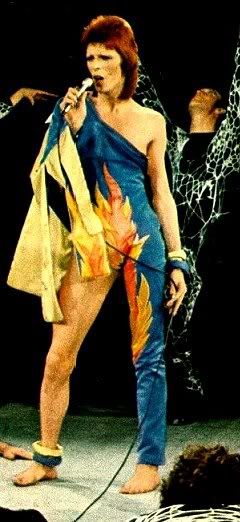
It’s easy to draw parallels from Gaga to other pop stars such as David Bowie, Madonna, and the late King of Pop. Indeed, Lady herself connects those dots. Some could even claim that she a a gothic Christina Aguilera of the era when she was singing songs like “Fighter” and making music videos of boys’ kissing. Despite Lady’s professions of raw originality, however, her image is merely a glossy amalgam of her own pop idols. Outrageous fashions and the quirky appeal to the marginalized of early Ziggy-era Bowie, unabashed bad-girl sexuality and proto-feminism of Madonna, and the slick production, coordinated dance moves, and seamless choreography of MJ, are all fused together in a girl who can actually sing, produced by people who are thoroughly schooled in pop psychology, and dispensed to the masses radio single after radio single. A grueling tour of live shows, in themselves grandiose productions not un-derserving of a Tony Award, support her recent album, The Fame Monster. She proudly proclaims that she lives for the show, that she revels in the glitter and drama and sound of it.

For Lady Gaga, fashion and music are one and the same. She has said that she writes songs based on an image of an outfit she has in her head; her songs are an excuse to wear something outrageous on stage. Each of her music videos feature her in no less than five outfits, and her taste in dress ranges from avant-garde pop diva to back alley prostitute to haute couture fashion model. Nothing is off limits, from a faux-nostalgic 1950’s dress to her monster ball outfit evoking the image on anime princess, or even a bra that spits sparks, if it fits her vision for art, she wears it. Makeup, outfit, props; the whole shebang is planned and executed in style.

While this is all grand and exciting, I can’t help but wonder what the overarching goal is. Especially in light of her newest single, “Bad Romance,” I have an uneasy feeling about where her career is headed. There is an inherent danger in living just for the show and soaking up the pleasures of a hedonic lifestyle; if you go and paint the town red, you will eventually run out of paint. As much as Gaga admires Bowie and his artistry, Bowie now is a far cry from the Bowie of the Ziggy, Thin White Duke, or “Let’s Dance” fame. He ran out of steam by the eighties and nearly crashed, resulting in him toning down his pop star image. If Lady Gaga thinks she can have all of the fun and none of the consequences, she needs to think again, because as it stands now, I see three possible directions that her career could go.

First, and least interesting, is that, despite her claims, that she is merely a cultivated pop icon whose script is written by record labels, no different from Ms. Spears. This would be incredibly disappointing for her fanbase, and detract a great deal from her ‘raw’ image.

Much more interesting and, in my opinion, necessary for the survival of her music career, is if Ms. Germanotta played Lady Gaga like Bowie played Ziggy; a pop act, no doubt, but an act that arrived, gained fame, and then left. Ziggy was a monstrous success - one that would probably have destroyed Bowie’s career should he have continued to play him. Bowie no doubt lost some fans because of the move, as would Ms. Stefani, but considering the alternative, I think it would be a wise move.

Equally interesting but decidedly hopeless is the possibility that Lady Gaga is all there is. I say ‘hopeless’ because, as I see it, her current persona - exemplified by the lyrics of (celebrating an emotionally parasitical and mentally unstable relationships) and accompanying video to “Bad Romance” - as unsustainable. That video (and other videos like it) is not the work of someone who is opening up new creative avenues; it is the aestheticization of a pop star’s destruction. Lady Gaga got the fame she wanted - the question is how long can she hold onto it? And if she does hold onto it, in which new, exciting direction will she take it?


_DZ


submit to reddit

11.25.2009

The Fleeting Value of Professional Sports When Viewed Through The Lens of a Traveller

As a kid, I was a huge sports fan. I watched sports whenever possible, played sports, and talked sports to whoever would listen. During my kindergarten and early elementary years I liked Japanese baseball, and followed teams like the Tokyo Yomiuri Giants, Orix Bluewave, Seibu Lions, and Kintetsu Buffaloes with enthusiasm. Unlike in American sports, where a city or state owns a team, Japanese sports are sponsored by companies - the Yomiuri is a major newspaper, Orix is a financial firm, and Kintetsu and Seibu are both railway conglomerates. Sumo was another favorite sport, and for the first two weeks of every other month my family and I would crowd around the TV during the 5-6pm hour to watch the great wrestlers duke it out with one another. Participation in soccer during my later elementary years paved the way for interest in the Japanese soccer league, or J.League for short. Favorite teams included the Yokohama Marinos, Kawasaki Verdy, and Kashima Antlers. Sometimes my private soccer club would play the elementary prep teams of these clubs, who were always formidable opponents.

During this time I also followed American basketball with a passion, the Chicago Bulls being my favorite team to follow. Every morning I would tear through the newspaper to find the sports section and read up on the happenings in the NBA, halfway across the world. If the paper happened to run a picture of MJ, it was a glorious day for my scrapbook.

Card-collecting was another way I was in-touch with sports. I collected baseball, basketball, and occasionally football cards throughout elementary, but only basketball card collection continued throughout middle school. Basketball cards were a way for me to stay close to my American roots, and I took great pride in my collection. A far as I knew, the Japanese card-trading scene was non-existent, and I saw trading cards as a uniquely American thing.

Interest in following sports slowly waned beginning in high school. I still played sports, but just didn’t care about sports as a whole as much. I had other interests, I guess, like music, cars, and computer games. I went to see the occasional game, but as far as memorizing stats and removing newspaper articles, that had ceased.

I had a brief love affair with European football (Arsenal woo!) in the past few years, but for the most part I have avoided following sports too closely. This year I tried to follow the international Formula-1 racing circuit, but lost interest half-way through June.

All this to say, really, that the more I think about it the more I can’t help but opine that following sports with enthusiasm is merely a construct of increased proximity - a mild form of nationalism, as it were. Right now I live in Minnesota, whose Vikings are 9-1. I don’t really care about the Vikings, yet find myself caught up in all the excitement over their new-found success. Come Monday I inevitably wander over to NFL.com to see how they fared the previous weekend. ‘They’re in MY city, and them doing well reflects well on me,’ I poorly rationalize. Why should I care?

If passionately following sports is indeed a mild form of nationalism, then it all seems very silly to me, a third-culture kid. I’ve seen kids crazy about J.League, teens going nuts over the NBA, college kids raving about their favorite English footy team, and adults getting uproariously drunk and high-fiving over a touchdown against those worthless Packers. It’s all the same everywhere. And what difference does caring about sports make, if indeed you’re only excited about the sport because of it’s proximity to your residence? When you move a lot, like I have, it becomes rather tiring to have to start all over again with a new sport or team to match each new city. Teams win, teams lose, and over the long run it seems pretty pointless and of fugitive disposition to get excited over the present state of a team. Equally useless is reminiscing over how good your football team was ‘back in the day’ (pre-2000 for Detroit. Zing.) Are there not better things to spend time on?

Obsessing over a sports team is revealed to be the hollow joy that it is when you confront it a set of eyes that have spent time examining it’s evanescent qualities regardless of the home culture. The only logical choice to make is to either follow sports passionately wherever you are, which quickly becomes exhausting, or to disregard sports almost entirely, by which you risk potential alienation at the water cooler. This is not to say that following sports is bad; sports, all sports, are exciting, electrifying, and, hopefully, God-honoring. But you don't need to follow any kind of team to enjoy it. I simply think that knowing beyond the simple “Yeah the Vikes played Seattle last weekend and won” is not worth it. It is simply too broad a world out there to narrowly focus on one little corner .


_DZ


submit to reddit

11.20.2009

Jump Rope 2: Jump Harder with a Vengeance


If you were at any time a Japanese elementary school student, it’s practically a given that you can jump rope at a professional level. I am not even joking. Japanese kids can jump rope like it’s their job. The public school system, subsidized by both the government and the jump rope industry, is largely to thank for this, as they make jumping rope a three-month-long mandatory P.E. staple. Prizes are given out to those who can jump rope the longest, resulting in kids jumping in class, starving during lunch, and wetting themselves on a regular basis. Learning to run while jumping rope is an important skill to learn at this stage in development. The highlight (or, for me, the lowlight) of the year is the school-wide competition that marks the end of the jumping season. This is where kids break out their Nike Shox, trash-talk dictionaries, and carbon fiber jump ropes and proceed to double-jump until their arms almost fall off. This routine is repeated ever year, so that the average elementary school graduate has (roughly) over 13,000 hours of jump-roping experience and no rotator cuffs.

Double-jumping, passing the rope beneath your feet twice in one jump, is not an easy task for a foreigner like me to accomplish. I never was able to do it, and this relegated me to 45th string on any and every jump rope team and exposed me to repeated kickings of sand in my face. You see, Japanese kids have refined jumping rope to a surprisingly deep level, complete with many different jumping styles, such as Aya Jumping, alternately crisscrossing your arms with each jump, and Kousa Jumping, in which you keep your arms permanently crossed while you jump. At the higher levels both of these techniques are combined with double-jumping, resulting in a whirr of activity that turns a cord of nylon into carbon-hardened steel and a mere elementary school child into its martial arts master, no doubt employable at a thousand different sushi restaurants nation wide. I, meanwhile, was off in the corner, spitting out sand and trying to synchronize my body so that both feet lifted off the ground at the same time.

For those less inclined to individual competition, jumping rope could be turned into a group exercise through utilization of the O-nawa, or large rope. This rope, held by one person on each end, was rotated slowly, the goal being to see how many kids could hop in and synchronously jump. I, of course, was still working on my coordination so I usually was relegated to be a holder, since I was tall for my age and could move my arm in a more or less consistent circular motion.


Japan, however, wastes this potentially profitable natural resource, as once the Japanese student graduates elementary, jumping rope is never spoken of again. It is treated as a stage in life that one must go through and then move on, much like soccer is considered in the US. It’s something that, regardless of how good you get at it, you must discard it and grow up. This means that now is the prime time in my life to get good at it, so I can reclaim some lost dignity from my youth. So if you’ll excuse me, I have some Shox to buy and some sand to kick.


Dann writes from his home in Minnesota where, unfortunately, his mediocre rope-jumping skills are his main way of keeping warm.


submit to reddit

11.18.2009

Nike, Iggy Pop, Shock Advertising, and Cleaning Up Public Space

If you follow my posts much, you know that I enjoy a good round of Guitar Hero. While Guitar Hero has been a source of new music for me from time to time, it has also helped me look at advertising habits at a deeper level, albeit indirectly. It was from playing Guitar Hero that I recognized this song (Iggy Pop’s “Search and Destroy”), and that allowed me to subsequently find the following Nike advertisement on YouTube.


That ad showed on NBC in 1996, during Game 6 of the NBA Finals. I was nine at the time, and was in the throes of Michael Jordan idolization. A family friend had taped Games 5 and 6 and mailed them to my family in Japan. The Nike ad only played once, but I watched the whole game so many times that the ad is permanently branded in my memory.

The content of the ad no doubt contributed to its "stickiness". Below is a haunting shot of a camera smashing at second thirty-one. That scene stuck with me more than any other.


The guy barfing is pretty dramatic, too.


The overall impression that I got from this advert was that sports was painful, hard, and punishing. There was very little glory depicted, and I certainly didn’t get the impression that Nike was the brand of winners. All the athletes involved wore Nike clothing, from Carl Lewis completing a successful jump to the guy on the ground trying not to be trampled.


Throughout the length of the video the two-second gratuity-shot of Scottie Pippen’s sneakers is all that really tells you that you’re watching a Nike ad. I remember those shoes well, though I never owned a pair because I thought they were ugly.


All this to say that this was the first instance of watching TV that made me uncomfortable. As I saw it, Nike had put together montage of people failing at sports and getting hurt in the process, all to sell a product. It was the first piece of video that I was fascinated by, because of the fast editing and pounding rock song, but didn’t actually like. The whole clip kinda made me nauseous, actually. Maybe the flying blood and the aforeinserted barfing guy had something to do with it.


This feeling, the feeling of “Why am I excited by this when it disgusts me?”, I think, is good to retain. So often we see things that annoy or shock us, but we are too jaded by a lifetime of media exposure to really care. There are biological ways we react to things, ways we don’t know about but advertisers do, that can catch us off-guard. A recent example might be this vile divorce ad.


It catches you off-guard just enough so that you might consider the possibility. We don’t need this kind of advertising here, there, or anywhere. These are the things we should search for and destroy.


_DZ


submit to reddit

10.29.2009

Corporate "Expertise" and "Beneficial" Beverages

I don’t buy soda very often, but occasionally I will buy some 12-packs if they are on sale. One such recent sale had me snapping up some Diet Coke Plus (marketed with slogan “We include the “L” so you don't make a wry face®”) which, as far as soda goes, is right up there behind root beer. Despite the colorful logo it seems that Diet Coke Plus has a hard time selling, because the advertising copy writers are now digging deep into their reserves of “phrases we can use to sell sugar water.” A quick picture of the box will explain what I mean.


Refreshing. Uplifting. Hydrating?
It’s true. Research shows that all beverages contribute to proper hydration. That means that whether it’s your first can of the day or your afternoon pick-me-up, Diet Coke Plus helps you stay hydrated all day long. So stick with the Diet Coke Plus taste you love. Your body will thank you for it.

While it’s true that drinking fluids does hydrate you, claiming that Coke is an efficient way of doing so is a lot like saying that smoking cigarettes "contributes to air inhalation and lung expansion," or that eating Twinkies "contributes to reducing hunger." It is technically true, but it’s not, as soccer players would say, in the spirit of the game. Appealing to the lowest common denominator, human health, is not an effective marketing strategy. Neither is suggesting that drinking carbonated soda in the morning is normal. Not even if you have an accompanying website.

Coca-Cola appeals to research, but they don’t tell who’s research. Their own? An independent third-party’s? Perhaps it doesn’t matter. Because they are an multi-national corporation, surely they can be trusted, right? After all, they have statistics, so they must be the experts.

Corporations claiming expertise is hot-button issue with me. A while back I went to a seafood restaurant. While I was being seated I was assured that a server would be with me shortly, and that they would be a seafood expert. Much to my astonishment, a teen-age girl soon arrived, menus in hand. Now, I wanted to give her the benefit of the doubt, but, having visited a world-class fish market years earlier, I already had a pretty ingrained image of what a “seafood expert” was. This girl, on the other hand, might not have known how to pronounce ‘cichlid’. My prejudice can perhaps be best portrayed in this Venn diagram.

Calling everyone who works for you an “expert,” whether in seafood restaurants, car audio installation booths, or cheap bars, doesn’t make me want to recommend your business establishment to anyone. I want to decide, to make the judgment, on whether or not you employ experts.

There’s a clerk at my local Hollywood video who "researches" so many movies that she writes her DVD rentals off her taxes as a work expense. She can recommend five other movies that you may like based on your current and past selections. If someone I know needs some movie variety, I’d send them to her. Likewise there is a hole-in-the-wall yakitori restaurant in Tokyo that I enjoy that was recommended to me by my friend, who himself is friends with a yakitori connoisseur. It is truly delicious, and it took two experts (the chef and the connoisseur) to allow me to partake in excellent yakitori.

But it’s not just the corporately-instituted “experts” that bug me - it’s the unique naming of employees by corporations in general. Some companies do it rather conservatively, like Wal-Mart (“associates)” and Target (“team members”). Other places do not fair so well. I don’t care what anyone says, putting ingredients that I ask for on my sandwich for me does not make someone a “sandwich artist”.

These days, corporately-bestowed expertise practically precludes actual knowledge or significant ability. Rather, customer-recognized expertise should be honored, and hopefully it is at thousands of businesses around the country. Is the flood of so-called “experts” a passing symptom of global corporatization, or a portent of impending mediocrity? Whatever it is, I think I now need a vitamin-enhanced water beverage with which to rehydrate myself.


_DZ

give po’ man a break


submit to reddit

7.21.2009

Trading, and The Capitalist Lie

On Sunday I listed my too-small road bike for sale on Craigslist, looking to sell it or trade for a bigger, better-fitting one. Within hours I had an email from a guy who wanted to trade his too-big-for-him bike for my smaller one. It looked like a perfect swap!


There was only one problem: I valued my bike at $500 and wasn’t sure that his was of equal (or, I guess, greater) value. After all, I didn’t want to get ripped off!

We decided on a spot to meet and decide if we wanted to swap bikes, and soon I was looking at his bike. It wasn’t a bad bike actually. It was quite nice. He was a nice guy too, and we chatted it up a bit.

What detracted from my being able to fully focus my attention on my new friend whom I had met (and who shared my interest in bikes!) was, of all things, my capitalist conditioning to try and figure out whether or not I was making a trade of equal monetary value. It was quite distracting.

Throughout the whole interaction I was our bikes and pricing them out in my head.

“Okay, aluminum frame. Mine is steel. I lose. He values his frame at $100, though. Mine is totally worth $100. I have a carbon front fork to his aluminum. Win. That fork is worth at least $70, maybe. I have twenty-seven speeds thanks to a Shimano Tiagra system. He has twelve, tops. Hah. Ooh, that’s a nice chainring though. He has better brakes, too. Full RX-100. Ummmmm. Ok but I totally have a better wheelset - that’s at least $70 per wheel. Plus I have good tires. Do I have a carbon seat post? I might. He sure doesn’t. Oh, do I see scuffs on those bars? Oh wait, mine are a bit scuffed too. Crap. Wow, does his seat ever look uncomfortable. Hmmm. I wonder if he’s doing the same thing in his head?”

This went on for close to an hour as we decided to ride our bikes on a nice, leisurely ride along a lake to get a better feel for them. I eventually had to tell myself to cut it out. It was getting too distracting, and besides, I really liked riding this bigger bike. It was really a nice bike.

We eventually completed the swap an hour and a half after we met, and I rode my new, bigger bike home. Had I gotten the better deal? I asked myself. I came to the conclusion that it didn’t matter. Pricing the bikes out in my head, trying to adhere to the capitalist lie of maintaining monetary equilibrium in order to be happy, had only led to confusion and distrust. At the end of the day, I was riding home on a bike that I was happy with and had made a new friend, and that was that. That’s all there ever should have been.


_DZ


submit to reddit