Showing posts with label humor. Show all posts

1.12.2010

If you understand this sentence, sasuga

A recent blog post by jibtv blogger Anna Kunnecke got me thinking about uniquely Japanese words. Her deconstruction of the word bimyou highlights what is so hard about the Japanese language - that is is full of words that represent abstract ideas. Bimyou is definable, but depending on the context will mean different things. Anna has already written about that word, so I will turn my attention to a different word: sasuga.

Sasuga is one of those words that Japanese ex-pats love to drop when talking with other ex-pats. (One of them even uses it as a clever title for his blog.) It can be an adjective or an adverb, and is defined something along the lines of “clever, adept, good, expectations, as one would expect.” Example dialog: “Did you just see what Gary did!? He climbed that 50-foot fence using only his arms!” “Ooh! Sasuga Gary!”

This use of sasuga would be appropriate if Gary had a penchant for climbing things with only his arms, but had never attempted something as tall as 50 feet. You would expect Gary to top his old record.

Sasuga also carries the connotation that you would not expect anything less of a person, and in this context can be used to create a humorous situation out of a decidedly maladroit action. If you already expected someone to screw up, uttering a sarcastic "Sasuga!" when they do something like this is appropriate.

It’s this dichotomy that makes sasuga a joy to utter and a bane to hear, because the the word can either be praising or belittling, with no audible difference in intonation. You just don’t know. You don’t know if your friend is praising you or veiledly saying, “Surprise surprise, you lived up to what we thought you could do.”

In this way sasuga is brothers (or sisters, if you prefer) with the term atarimae, which means ‘expected’, ‘reasonable’ or ‘blatantly obvious.’ In Tokyo, for instance, it is atarimae that the trains run on time. Knowing the connotations of atarimae is extremely helpful, because if someone does something that is atarimae only to receive a reply of “sasuga,” then it is likely a sarcastic comment.

All this to say that when a foreigner new to the country hears the phrase “sasuga gaijin(foreigner),” they have no way of knowing whether or not it is a complement, because they have not yet learned what is atarimae and what is not. It’s one of those things you have to, as Anna says, take as a quicksilver-kind of word and go with the flow until you can determine the context. And if you figure out the context more quickly than your other gaijin friends, then I have one thing to say.

Sasuga!


_DZ


Dann writes from his home in snowy Minnesota, where sasuga is the correct response to -15F weather.


submit to reddit

11.20.2009

Jump Rope 2: Jump Harder with a Vengeance


If you were at any time a Japanese elementary school student, it’s practically a given that you can jump rope at a professional level. I am not even joking. Japanese kids can jump rope like it’s their job. The public school system, subsidized by both the government and the jump rope industry, is largely to thank for this, as they make jumping rope a three-month-long mandatory P.E. staple. Prizes are given out to those who can jump rope the longest, resulting in kids jumping in class, starving during lunch, and wetting themselves on a regular basis. Learning to run while jumping rope is an important skill to learn at this stage in development. The highlight (or, for me, the lowlight) of the year is the school-wide competition that marks the end of the jumping season. This is where kids break out their Nike Shox, trash-talk dictionaries, and carbon fiber jump ropes and proceed to double-jump until their arms almost fall off. This routine is repeated ever year, so that the average elementary school graduate has (roughly) over 13,000 hours of jump-roping experience and no rotator cuffs.

Double-jumping, passing the rope beneath your feet twice in one jump, is not an easy task for a foreigner like me to accomplish. I never was able to do it, and this relegated me to 45th string on any and every jump rope team and exposed me to repeated kickings of sand in my face. You see, Japanese kids have refined jumping rope to a surprisingly deep level, complete with many different jumping styles, such as Aya Jumping, alternately crisscrossing your arms with each jump, and Kousa Jumping, in which you keep your arms permanently crossed while you jump. At the higher levels both of these techniques are combined with double-jumping, resulting in a whirr of activity that turns a cord of nylon into carbon-hardened steel and a mere elementary school child into its martial arts master, no doubt employable at a thousand different sushi restaurants nation wide. I, meanwhile, was off in the corner, spitting out sand and trying to synchronize my body so that both feet lifted off the ground at the same time.

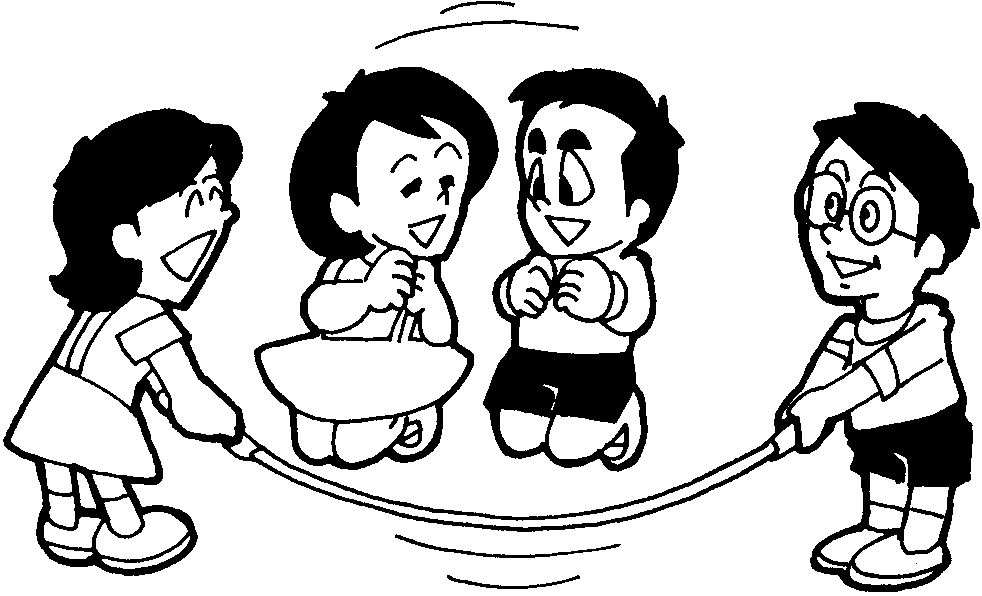
For those less inclined to individual competition, jumping rope could be turned into a group exercise through utilization of the O-nawa, or large rope. This rope, held by one person on each end, was rotated slowly, the goal being to see how many kids could hop in and synchronously jump. I, of course, was still working on my coordination so I usually was relegated to be a holder, since I was tall for my age and could move my arm in a more or less consistent circular motion.


Japan, however, wastes this potentially profitable natural resource, as once the Japanese student graduates elementary, jumping rope is never spoken of again. It is treated as a stage in life that one must go through and then move on, much like soccer is considered in the US. It’s something that, regardless of how good you get at it, you must discard it and grow up. This means that now is the prime time in my life to get good at it, so I can reclaim some lost dignity from my youth. So if you’ll excuse me, I have some Shox to buy and some sand to kick.


Dann writes from his home in Minnesota where, unfortunately, his mediocre rope-jumping skills are his main way of keeping warm.


submit to reddit

5.19.2009

Ketchup - A Brief History of The World's Greatest Asset


Ketchup is possibly the greatest invention of modern, pre-modern, and post-modern times. The lovely red pasty stuff that you squirt on your burger and fries has been at the forefront of the advance of modern civilization and general morality, but chances are that you are not aware of it! For shame! But have no fear; for this article will follow the history of the condiment known as ketchup and use brilliant anecdotal evidence to prove how ketchup is the source of everything good in the modern universe. Read on, soon-to-be ketchup lover!


Pre-Early 1600 - Ketchup is only known in China. It is unsurprising, therefore, that up until this time there has been war, strife, feudalism, the Crusades, the Inquisition, Cortez committing genocide in Mexico, and many other atrocities in Europe and the New World.

Early 1600s - The Dutch bring back ketchup from China, resulting the the financial success of the Dutch East India Company. Unsurprisingly, in China, the Ming Dynasty that has been dominant since the 1300s fails in the next forty years, eventually ending in 1644. They should not have shared their ketchup.

1700s - It takes a while for Europe to get into the swing of things, but soon the Enlightenment period begins, thanks to the effects of ketchup in increasing human mental capacity.

1727 - Britain has ketchup, and the first recipe for ketchup is printed in Britain. The Spanish want the recipe, but Britain won’t give it to them, so they war for it, sparking the Anglo-Spanish War. Nobody wins, the status quo is unaffected, and Spain goes home without ketchup. British minister John Wesley invents Methodism in celebration. Ketchup actually goes on to fuel much of England’s dominance in the next fifty years or so.

1801 - Benedict Arnold, the American traitor, dies, and the first recipe for ketchup is printed in America. This is not a coincidence. While Britain and France were warring it out in Europe (Britain was mad that the Americans stole their ketchup, and Napoleon was mad because he wasn’t British), America is a budding new country full of promise and smart people like Thomas Jefferson, who came into presidential office that year.

1812 - A better recipe for ketchup was published in America, causing the British, still sore, to try and war against America. America, fortified in large part by ketchup jars passed out in their troops’ rations, beats the Brits back.

1830 - Ketchup starts being sold in bottles, and Emily Dickinson is born. She goes on to write many poems praising the many benefits of ketchup, but these are collected in a tome that has yet to be discovered.

1837 - A man named Jonas Yerkes, a Michigonian, starts selling ketchup in quart and pint-sized bottles. The bigwigs in Washington DC are totally impressed, and unanimously vote to let Michigan become the 26th state of the Union. They need some way to tell Michigan this, so they commission a Mr. Samuel B. Morse to do something about it. The telegraph is invented. Michigan needs a commercial hub out of which to ship their ketchup, so they decide to create a sleepy little township nearby, call it Chicago, and ship ketchup from there.

1848 - Unscrupulous bachelor ketchup bottlers in Wisconsin start adding coal tar to heighten the redness of their ketchup. This results in about 5,000 deaths in New York City. Legislators reprimand Wisconsin, which has yet to achieve statehood, and demand that they stop. Wisconsin agrees and turns their efforts to cheese-crafting, which so impresses lawmakers that they make Wisconsin the 30th US state. All is forgiven and the 5,000 avoidable deaths in NYC are blamed on “rampant and uncontrollable cholera.”

1876 - It’s a big year for ketchup. John’s Hopkins University is created to (indirectly) help sick people. A man named Alexander Graham Bell wants to tell his friend HJ Heinz about this, and devises the telephone. Heinz receives his telephone in the mail, and the two talk for hours on end about how they can help sick people for less money than it takes to found a fancy-schmancy university. Heinz decides that his new recipe for ketchup will make a world of difference, and launches Heinz Ketchup Co. to (directly) make people healthier. Also around this time, General George Armstrong Custer tries to make friends with nearby Indians in Montana but forgets to bring ketchup along. The Indians, incensed at his unbelievable lack of foresight, slaughter him and his group of friends.

1877-1981 - Ketchup starts being taken for granted and drops out of the public eye. Enter WWI, WWII, the Holocaust, and the Vietnam War.

1981 - Ronald Reagan, an actor/president, signs social reform legislation that results in severe problems for homeless people. He also introduces the “trickle-down effect”, which has yet to actually work in real life. Directly related to this is his mistaken idea that ketchup is vegetable suitable for school lunches. Ketchup is clearly a condiment, and an avid supporter of ketchup takes a few potshots at Ronald. Reagan emerges a national hero as the first president to survive an “assassination” attempt.

1992 - After an extended hiatus, A Prairie Home Companion returns to the American airwaves. Its Catchup Advisory Board short skits promote the myriad benefits of ketchup, and the show prospers.

October, 2000 - Heinz introduces ketchup in a variety of fun, colorful flavors. They also make contributions to George W Bush’s political campaign. In the years following, 9/11 happens, the Iraq War commences, and Dem. John Kerry does not become president. Heinz ends the colors in 2006, and two years later Barack Obama is elected the first black president of the United States. Progress!, and proof that ketchup needs to stay red.


Man, if that doesn’t prove how great ketchup is, I don’t know what does. If fact, if you still don’t believe that ketchup is awesome, I think you need to scroll up and read the timeline again. Ketchup is so awesome that I buy it in bulk. If the local Restaurant Depot ever has too much ketchup it’s because “that guy didn’t come in this week”. Now if you’ll excuse me, I have to go grocery shopping for things to eat with my ketchup.


Dann writes out of his home in Minnesota and owns every color of ketchup, but only for collector’s value.


submit to reddit

4.06.2009

Samson: Unbelievable He-Man and Also a Closet Poet!

About a week ago I flipped on NPR and heard a guy talking about his new book. He, a non-practicing Jew, decided to read the Bible cover to cover from the perspective of someone who had never read it before. He wanted to give the general public a fresh look at what was really inside the Bible. From what I heard him say, it was evident that his reading comprehension wasn’t that great, but it did make for an interesting idea. I have been learning about the Bible since before I could read, so such a task is considerably harder for me, but this year I am also reading through the Bible, cover to cover, and a few stories have shone in a different light for me.

One of those stories is the one about Samson in the book of Judges. Every little kid who has been to Sunday School knows that Samson is one of the strongest men in the Bible and a “Bible hero” that people love recounting stories about because it makes good narrative. But have you actually thought about the stories told about Samson? I could recite them all to you, but I had never actually thought about them and considered the implications.

Samson is a dude whom God appoints as one of Israel’s judges but in reality does a lot more of beating Israeli enemies down than he does judging Israel. He’s a violent guy who goes on destructive temper tantrums brought on by grievous Philistine actions. One famous story involves him killing 1,000 Philistines with the jawbone of a donkey.

A thousand people! Dead!

I always had the mental picture of Samson using a half a jawbone instead of a whole jaw assembly, but he could have used that too. Either way, that’s a lot of people bludgeoned to death with a piece of bone.


Several questions immediately pop into mind. The first one being, “What were the last hundred Philistines thinking?” I mean, they just saw Samson destroy 900 of their comrades. Did they think they had a chance? They probably had to climb over their own dead just to get to him!

Secondly, how long did this take? Maximus (from the film Gladiator) can win at hand-to-hand combat in about seven seconds, but he has a sword, so let’s say that Samson dispatches these guys at a rate of 1 every 25 seconds. That’s 25,000 seconds, or about 417 minutes for the whole lot. About seven hours of slaughter, though probably much longer. Did this become a spectacle event? Were there shepherd boys sitting on the hills cheering and keeping a running death tally?

And what does Samson do after he kills all these guys? Does he loot them for stuff? Does he take a drink of water? Does he spit on the corpses and walk away? No! He sits down and thinks, “I’m pretty frickin’ awesome. Man, am I awesome! I need to write a poem about how awesome I am.”

And he does!

After seven hours of bludgeoning grown fighting men to death, he sits down and writes, “With the jawbone of a donkey, I have made donkeys out of them / With the jawbone of a donkey, I have killed a thousand men.”

Truly there has never been a finer example of brazenly self-centered, raw, masculinity.

I wish I had thought about these stories in this type of way much earlier! I wonder what else the Bible has in store?


_DZ


submit to reddit

4.02.2009

A Wave of Psychologically Distressing Entertainment On The Internet

In the 1930s cultural and literary critic Walter Benjamin penned his observation of mankind”s “self-alienation [having] reached such a degree that it [could] experience its own destruction as an aesthetic pleasure of the first order.” He was referring to destructive practices that we find commonplace today; things like building a full movie set only to blow it up in a stunt. It was waste, pure and simple, but the moviegoers loved it. And because it was profitable, it stayed. Nowadays we don’t think twice about chase scenes in which hundreds of car get totaled - it’s just good cinema!


But I think he was onto something, and I want to take his observation and apply it to a new, disturbing phenomenon that is growing in todays Internet culture. It seems to be everywhere you browse, and thanks in part to the anonymous and unfiltered nature of the Web, is growing quickly. I’m referring here to the trends of scathing satire, celebration of deviance, a pathological focus on negative events, and dark humor. The glamorous trivialization of the depraved human condition that looms over our psychological well-being.

Now the content of this wave is not new per se. Throughout history we have laughed at one another’s misfortunes, enjoyed violence as entertainment, and in general indulged in activities that were not helpful in our development as a loving, caring race. Dead baby jokes are still told. What has changed, however, is the way that this content is distributed, the scope of its reach, and the way in which we as a(n) (internet) culture participate in it.

Before I start listing examples, I want to emphasize that all of the content that I will reference is available for free, online. There is no cost involved other than a computer and an Internet connection. This is a major point, because before the Internet the only way that someone could reach a large audience was to publish in some way or another, whether it be books, magazines, film, or syndication. This not only involved some degree of scrutinizing censorship, but it cost money and, accordingly, consuming it cost a person money. Before indulging in any material, the consumer had to judge whether or not the entertainment he would gain was worth the value of his money. This was an important step that is now bypassed thanks to the Web. Social site-aggregator sites like Reddit.com and Digg.com help to popularize this content, making it easy to find for people who are looking for a quick laugh.

Dark Humor Comics

This genre of comics has exploded in the past couple years, with sites such as garfieldminusgarfield, Perry Bible Fellowship, Saturday Morning Breakfast Cereal, and Cyanide and Happiness quickly gaining thousands of subscribers. These comics focus on themes such as depression, isolation, death, mental illness, suicide, often portraying their depiction and satire of real life in the light of extreme irony. They are colorfully drawn, and hide their disturbing content behind the smiling faces of their characters. They provide the reader with his or her daily dose of dark humor derived from the dysfunctional areas of daily life.


Dark Humor Cartoons

These aren’t as popular as they used to be (at least I think so), but they are also along the same lines, in terms of subject material, as the dark humor comics. These animated shorts on sites like HappyTreeFriends.com and Killfrog.com feature slapstick violence way above the level of Tom & Jerry and often surpassing controversial cartoons like South Park. Explosions often result in maiming, dismemberment, and death of small animals or humans. Again, these are cartoons that would never be able to turn a profit on TV or even straight-to-DVD releases and can exist only on the Internet, where teens and college students can watch them and laugh. The YouTube channel of MondoMedia, the creators of Happy Tree Friends (whose videos are too disturbing for me to embed here), has been viewed over seven million times, with their cumulative video view count no doubt in the twenty to thirty million range or higher.

Satire/Fratire

Sometimes people get really drunk and do stupid things. Most of the time those aren’t things you want to talk about, unless you are a “fratire” writer. This is a genre of prose in which the writer is dedicated to getting really drunk and recording every outrageously socially insensitive thing he (they’re almost always male) does (thanks to a tape recorder he takes with him). Thanks to blogging, these writers’ sites become popular destinations for college-aged guys who need a partying role-model of sorts. A guy named Tucker Max, a self-proclaimed asshole, is undoubtedly the most popular writer of this genre, even producing a book entitled I Hope They Serve Beer In Hell. Max knows how to write a funny story, and uses his relationship blunders and drunken sexual escapades as “good” subject material. Fratire is excellent example in which a writer gets famous only because of the nature of the Internet. Tucker is now a prominent New York socialite, though new stories have been added to his site less and less frequently. The aim of these sites, such as TuckerMax.com and SlowChildren-AtPlay.com, is never to educate anyone - only to shock and “impress” the reader.


At-Least-My-Life-Isn’t-That-Bad Sites

Complaining to friends about how life seems unfair at times is something we all do at one time or another. We all need to vent and be comforted. Most of the time these stories of woe are not particularly humorous, but when then are, we laugh at them. And when the Internet comes into the picture, thousands of people can laugh at them. Enter FMyLife.com, a site to which people can upload short stories of how their day went wrong, ending each story with three letters: FML. F*** My Life. A site that people can visit in order to laugh at the misfortunes of others and even rate those unfortunate experiences (“Did the subject deserve it or not?”). A site that, thanks to the anonymity and impulsive nature of the Internet, allows people to publish how their professional lives, personal lives, relational exchanges, and sexual escapades went awry. Each story is meant to evoke a “Haha! I would hate to be that guy!” type of response from the reader. And there are over 2200 of these stories, with about 15 new ones being added every day. It used to be that teen and gossip magazines had a monopoly on these tales of rueful woe - now they’re everywhere.

Another site in the same vein is the aptly-named Complainary.com, which touts itself as a place for people to vent. Not content to merely feature paragraph-length stories, the Complainary actually hosts whole articles and blog entries dedicated to ranting about how much things suck. Very little of the material is even remotely constructive, and Complainary is actively recruiting people to write for the site, clearly trying to push the complain-anonymously-online movement along.

These examples are just a taste of all the distressing content that is out there; a mere drop in the digital bucket. Economics would tell us that the market is just catering to the needs to the consumers, i.e. where the market senses a demand for a service or product, it will create something for the demand to consume. So, in a way, the blame could be placed on the people who supposedly desire this kind of entertainment. The resulting dark humor must be just a passive product of the masses wants and desires. I don’t agree with this, because I don’t believe that traditional economics apply here. The Internet is the first place in human history where people can reach a mass audience for next to free. Consequentially, this allows them to do their own thing and make content that they want to make. The argument becomes, “Because the audience on the Internet is so expansive, if I put out content, surely someone who likes it will find it. They will then tell their friends, and the chain continues.” Thus, someone who makes (subjectively) decent content, like dark humor comics, can effectively create an artificial demand for their service with no risk involved. If they become popular enough, then they can branch out and actually try to make a living off of their site, whether that be by selling advertising space, clothing, or other merchandise that relates to their site. Truly this is entrepreneurship at its finest.

And this is not going away. For perhaps the first time, artists who were told, “You will never make any money drawing those silly comics,” actually can. Being paid for doing what you love is incredibly enticing, and people will flock to this opportunity.

But, nonetheless, I worry about our collective psychological well-being. The rise in depression and isolation in the past several years is brought on, I think in part, by our attachment to our machines. It’s no secret that art is reflective of the time period in which if was created, and as print comics die and webcomics flourish, their gravitation towards the dark themes in life, and our derivation of pleasure from it, is just a natural byproduct of our society. And thanks to the Internet, it proliferates rapidly. And what about fratire, FML, and The Complainary; trends that celebrates human deviance and misfortune? Will they continue to grow?

I certainly hope not.


_DZ


submit to reddit

1.18.2009

How to Win any Girl's Heart, (Online)

I wrote this article back in 2006, in a hospital in Pennsylvania. I had just been diagnosed with diabetes, and needed to write something to lift my spirits. It's definitely not some of my best writing, but hopefully you can enjoy it for what it's worth. The piece is, of course, incredibly sarcastic, and as such should be taken with a grain of salt or two. Or six. _DZ


How to Win any Girl's Heart, (Online)

I am the funniest man ever (online). No joking. Give me some basic background on a girl, her screen name, some time, and I will be the man of her dreams (online). I say all the right things, am interested in all the right things, and am generally just on the up-and-up about everything in an online conversation (convo). "That's so cool," you say. "Dann, how can I be like you," you ask (if you're a guy, ideally). I get asked this all the time. In fact, I recently made a list because I get asked so much (really). This article is on a pretty tight deadline, so I'm gonna just paste my list below to fill up some space.

Dann's Semi.Secret. Wooing A Nice Girl - Online (S.S. WANG-O) List

Point No. 1 – Choose an appropriate screenname. Girls are much more likely to talk to you seriously and not take you as a joke if you have an unobtrusive, slightly mysterious screen name. This may sound silly, but it's totally not. It's a totally important point. Using that AOL screenname you made in 6th grade (sk8rde4thXXX) to get in on the cool kids group chat (7-9pm every weeknight) will not get you anywhere with the college ladies. For demonstration purposes I will model my not-real suave screenname that I've had for ages: freebluevalley87. This one is a sure winner. 'Free' has very positive connotations, as does 'blue'. (Blue is just a cool color.) Words like those just makes people feel calm and relaxed. The '87' is in there because it gives away my birth year without screaming I'M TWENTY-ONE. If she's clever, she'll guess the significance of the number. I threw valley in there because it really doesn't fit, and is bound to be a good convo starter.

Her: why valley??
Me: Why not?
Her: lol kk

This brings me to Point No. 2, – Try to follow basic spelling, punctuation, and grammar. This will make the girl that you're conversing with feel that you are serious. 'But wait!,' you say, 'usin correct spelin iz 4 lyke total chat n00bs MIRITE?' ...That is true. However, you're not 13 anymore so you don't need to talk like someone who just learned that E can be replaced with 3. ROFL. Feel free to throw in some (well-thought-out-beforehand) leetspeek into your convos, (sarcastic leet is always welcome) but for the most part, keep it to pretty good English ;). Phrases to avoid if possible: lol, mmmk, tite, kool, w00t, ur, u r, ttyl, enkay, frealz, !!!!(only one needed!).
Point No. 3 is to – Think out your responses ahead of time. Remember this is online, and, unless you're webcam-chattin' it up, she can't see you. Many people might think this is cheating but it's definitely not. Type up a witty response, think it over, erase it, and write a better one. Rinse and repeat if necessary. You don't want to sound like an idiot if you don't have to. Sure, she'll see the “freebluevalley87 is currently typing a response” message on her screen a little longer than your response would warrant, but that's ok. Remember, capitalizing and good grammar will theoretically take time. Plus you might be looking stuff up.

All people now-a-days have a profile page on a social networking site. It's a given. Chances are, the girl you're talking to will have such a page. Find this site. In fact, Point No. 4 – Have quick access to any digital information you have on your convo partner close at hand. I realize that that is a rather long Point 4 and that this is still bolded (oops) but bear with me here. Facebook, MySpace, Xanga(maybe), LiveJournal(not ideally), and Hi5(heaven forbid) are all good sources to get info on your chat partner. You should have an account on each of these sites (except Hi5). A certain gender tends to post a lot of personal information on these sites and then forget about it. Use this forgetfulness to your advantage, guys. Ladies, it is not stalking for a guy to know this info. The Internet is not your fuzzy orange diary in your desk. People can read your profile page, memorize it even, and it is not creepy. (Unless they're 30. Then it can get kinda creepy.) Guys, it might even be a good idea to record chat logs. Then in your spare time you can add them to a database for easy cross-referencing should you need to remember what your convo buddy thought on a certain matter.

Point No. 5 (Find and have useful resource websites at the ready while chatting) goes well with Point No. 4. Knowing sites that will quickly give you information on things you know nothing about is a must for a debonair online gentleman. Sites like Dictionary.com, Wikipedia.org, Urbandictionary.com, Google.com, and others will make you seem like you are all on the up and up. Nothing is more embarrassing than not knowing what your chat-mate means when they use a certain word or bring up an obscure topic. If you're using a Windows PC, the Trillian chat client made by Cerulean Studios (www.trillian.cc) combines MSN, AOL, Yahoo, IRC and ICQ messengers into one handy client. But that's not the reason why it's cool. It's cool because it allows you to right-click any word you don't know (or even one you do) and see the Wikipedia entry on that word (if it exists). I can't tell you how many times I've used this to eliminate an awkward online pause caused by having to go look up a word. That's a tip guys, write it down. Girls, don't read the above paragraph.

Point 6 - Avoid YouTube.com. This has nothing to do with attracting girls, but will save you a lot of time.

So there are all six of my Super Secret points. You can follow them to the number, or live dangerously and try to venture out on your own. Really, though, chatting it up online is not that hard if you follow these basic rules. Have fun, be safe, be attentive, and things will surely go your way every day. Eventually, you might be able to be as cool as I am. But don’t count on it. It took me a long time to come up with these and perfect them, so don’t think that you can do it all in one night.


_DZ


submit to reddit