4.29.2010

I Was in a National Newspaper!

Anybody who has googled me recently (try it today!) knows this already, but a couple months ago I was interviewed by Sandra Block for her column in USA Today. For those of you who don't want to click on the link, here is the part mentioning me.

"...many consumer experts say that responsible use of credit cards is one of the most effective ways to build a good credit record. Those concerns haven't swayed Dann Zinke, 22, of St. Paul, who works at a gas station to save money for college. He's never owned a credit card and doesn't plan to get one any time soon. 'I refuse to recognize it as a rite of passage into adulthood,' he says. 'I don't want to go through the hassle of signing up and receiving other credit card offers.'"

I don't remember saying the second line, but the first line of my quotation I found rather clever, if I do say so myself.

Surprisingly, it wasn't that hard to contact a reporter of a major newspaper. I had heard her being interviewed on MPR, talking about how she was soliciting stories from twenty-somethings who didn't want credit cards. I emailed her about that, and she got back to me right away, wanting to set up a phone interview. She called me the next morning and we talked for maybe fifteen minutes, tops. I had over-prepared for it, of course, and had three pages of notes detailing what I might say, none of which I had time to use.

Overall I found the article encouraging. Despite it opening with a non-sequitur (Emily has never had a credit card, yet she has also never felt comfortable owning one?) I thought it provided a very balanced view of the pros and cons of credit card ownership. In particular I appreciated the highlighting of the increased use of debit cards, because without mine I would be up a serious creek without a paddle. Or in a serious supermarket without a checkbook. I only write checks for rent, and am guaranteed to make a horrible checkbook-balancer. Though the article claims debit cards as less secure than the credit kind, as long as I keep mine in my wallet and use it only when I need to, I think I will be OK.


_DZ submit to reddit

4.17.2010

Free Chrome Shoes and Wildly Effective Internet Guerrilla Marketing

So yesterday a free pair of brand-new shoes showed up at my door. Yeah, you read that right. I got a free pair of shoes shipped to me from California. So how did I get this sweet deal? Pretty simple. I hang out with people who ride bicycles, and we all hang out on the Internet.

As geeky as that sounds, it is true. Chrome Industries is a bicycle apparel company out of San Francisco, and they had a two-day Internet marketing campaign back on March 17 and 18, spread through Facebook and Twitter. The promise was simple - “Send us a pair of your old, crappy, beat-up shoes, let us know your address and shoe size, and we will send you a brand new pair of our shoes.” Not only that, but they promised to donate to charity the shoes that could still be worn and recycle the rest that could not. Sound too good to be true? My cyclist friends found out, told me, and I hurriedly mailed away an old pair of sneakers, because I am a man who likes to get free stuff. (One of the many traits I share with the elite 15-98 year-old cyclist demographic.) And guess what? My new shoes, which normally retail for $70, showed up yesterday. They look like this, which pleases me greatly, because my current shoes look like this(but whiter).

I don’t have to tell you that this was a gutsy thing for Chrome to do. They no doubt gave away thousands of pairs of shoes for free. It cost them a lot of money in postage to ship shoes all over the world (the campaign wasn’t limited to the US). They had a lot of logistics to cover to ensure that they could fulfill their promise. And what were they thinking, potentially alienating their hardcore fanbase by giving away an expensive product, an urban cycling status symbol?

But that doesn’t matter, because as I see it, they just pulled off an extremely successful guerrilla marketing scheme that penetrated a very niche market with great depth for very little cost. Hundreds of thousands of cyclists will now here the word “Chrome” and instantly think of environmental responsibility, quality products, and the giving away of sweet loot. Not only that, but the total number of people wearing Chrome shoes in the world just doubled. And I wrote a blog post about it. It would have taken a lot of money and a super-effective traditional advertising campaign to get anywhere near the same effect. Every time I get a comment on my Chrome shoes I will answer, “Yeah, I got them for free. Chromes are sweet!” Even people who don’t care one bit about Chrome shoes will have to put up with me telling about how I mailed in a beat-up pair of Adidas and got a free pair of Chromes.

But what about those people who didn’t get them for free but rather bought them new? Now their (admittedly small) reference group is flooded with shoes that, to be honest, cost a lot of money for what you get. Chromes are more cycling status symbol than comfortable shoe. Those early adopters are now going to be stuck with a bunch of people riding bikes asking each other smug questions like “Hey dude, nice Chromes. How much did you pay for those. Wait! Let me guess!” Maybe we will get some lamenting of all the newbies ruining the Chrome “scene” with their “poseur” ways. Maybe Chromes will go “mainstream” and now owning a pair will be “so 2009”. Regardless, Chrome has made a lot of people happy, and I know that if and when I am in the market for a new messenger bag, there will be one place that will totally hook me up.


_DZ


submit to reddit

4.01.2010

Isaiah 43: 5-7

5 Do not be afraid, for I am with you;
I will bring your children from the east
and gather you from the west.

6 I will say to the north, 'Give them up!'
and to the south, 'Do not hold them back.'
Bring my sons from afar
and my daughters from the ends of the earth-

7 everyone who is called by my name,
whom I created for my glory,
whom I formed and made."


April is the month of every year with the highest number of suicides, so be nice to your neighbors. If you have an encouraging word to spare, say it.


Thank you.


-Dann


_DZ


submit to reddit

3.01.2010

Computers In A Time Continuum and Also My Awkward Middle School Years

I’ll start this out with this picture that doesn’t serve any purpose but to remind me of days gone past.


Madden 2011 is coming out. The last time I cared about Madden was 2001, when Eddie George, the guy in that picture, was on the cover of the game. I was in 8th grade at the time, and when you’re that age video games are the greatest thing around. Actually, electronics were pretty much the greatest thing around, too. Throughout seventh and eighth grade I was obsessed with computers. I got my first computer, a laptop running Windows 3.1, in 1999 and we were pretty much inseparable. My life goal at the time was to have a printer in my room (sadly this never happened).

That laptop didn’t have a CD-ROM drive, so I played Madden on my dad’s desktop. My parents were pretty strict about computer usage, limiting my access to an hour a day. This was before I we had the Internet at home, so pretty much the only thing to do on the computer was play games. I spent countless hours in front of the screen playing Madden, making sure that I had all the top players in order to have a guaranteed win at the virtual Super Bowl. (It actually was even less of a deal then it seems, because if I lost I would just not save and restart until I won.)

Madden (and my laptop) started a trend of sorts - one in which I valued gaming and technology more than learning and studying. I was never a big fan of schoolwork in high school, which is something I attribute to my middle school habits. School wasn’t cool or attractive, and technology was. If a school assignment couldn’t be done on a computer, is was by definition less important. I went out of my way to use computers to complete projects even if it was easier to do it without one. This is probably the main reason why I have terrible handwriting now as an adult.

But back to school itself. It wasn’t that I didn’t like learning - in fact, I don’t think anyone dislikes learning - only that I didn’t like or wasn’t good at school. The cool subjects to study in school were binary subjects like math and science. It was easy to compete with classmates there - you either got the answer right or you didn’t. I liked competing, but I wasn’t very good at math and science. The other subjects, particularly English, were ones that I was better at but didn’t really like. I could write and spell and identify parts of speech and prepositional phrases, but where did that get you in school? Also, literary criticism? Boooooriiinng. So I went through school not good at the stuff I wanted to like and ignoring the stuff that I was good at.

My way to psychologically get around this was to choose style over substance and use a computer for everything. This was how I got through my eighth grade science project. I chose magic squares for my project- a topic I and no one I knew had any clue about. My entire project was research and presentation - I made no hypotheses, did no experiments, and produced zero original material. But it did use computers! When the fair date came around I dutifully set up my presentation about a part of recreational mathematics that had no real-world applications. The guy kitty-corner from me had built his own wind tunnel. I stood there in my sweater and tried to forget that middle school was not a great time in my life.

In high school I tried to do as little work as possible in my classes and usually pulled Bs. The science and math homework was done at the minimum; sometimes copied. The English work was done at the last minute because I could easily hammer out a paper or two. All of my papers were typed, all of my images harvested from the web, and all of my tables and graphs done in Excel. When I got to senior year I dropped math and science all together. I had earned a D in pre-calc the year before and wanted nothing more to do with math. I remember sitting down to my first class of physics my senior year and getting a homework assignment of all the odd problems on a worksheet. I looked at the paper on my desk and thought, “I hate lists of problems. And I am not spending my year doing work that I hate.” That was that, and I dropped physics. All that stuff about wave dynamics and planetary gears and the square root of the length of a pendulum being proportional to its period and what not, who needs it? I decided to take Yearbook, because then I could sit in my corner in front of a screen and work on layouts.

Computers, on the whole, probably made me a worse student. I don’t regret the skills I learned from all the time spent with a computer (after all, I do spend a few hours every day using one), but I do regret thinking that computers would solve all of my problems. They don’t, and they never will. I used them as a substitute for effort, and that was wrong. In this age where “efficient use of technology and information are going to be of paramount importance as we move forward to cure the ills in our present world,” the microchip is hailed as the universal band-aid; the zenith of human achievement. But let’s not fool ourselves; cavemen probably said the same thing about hammers and axes. Agrarian man hailed the plow and the windmill. Then came electricity and vaccines. The car. Nuclear power. Computers are part of a grand continuum of human self-delusion. I was obsessed with Madden for a short time, years ago. We as a culture have been obsessed with our own grand progress for much longer than that.


_DZ


submit to reddit

2.26.2010

Hipsters In High Town

Is the hipster movement dying down? Probably not. At least not till they run out of money. Because that’s all it is - group of young people with too much money and not enough time. Not that there’s anything wrong with having money, but when an entire social movement is centered around available buying power and status symbols rather than ideology or political reform, there is no winning way out. There is no goal to reach, no final destination. Only enjoyment of material comfort until the cash runs out. It’s a total lose-lose situation.

Have there been any other social classes based entirely on buying power? I can only think of two: the formation of the middle class in the early nineteenth century and the burst of yuppie culture in the late twentieth. Both yielded a pornocopia of new trends and fashions, rooted in the newfound leisure time that they had or the wild increases in salary speculations, respectively. Emergent-middle class Britons had more time then they previously knew what to do with, and twenty-eight-year-old financial advisors in New York made more money in a week then their blue-collar grandfathers did in a year. Middle class citizens (aided by the consumer revolution) redefined what it meant to live comfortably. Suburban anywhere would never be the same. Yuppies, however, succeeded in nothing more than annoying millions of sensible people, mostly from the already-comfortable middle class.

THE ANTICREATIVE

Hipsters lie well outside of that cultural creative plane. They aren’t redefining what it means to live a certain way nor are they curating a mindset in which they view themselves as the acme of human achievement. The ideal hipster, cigarette dangling from his lips as he leaves his loft to mount his brakeless bicycle. Wearing his keffiyeh, skinny jeans, and emo glasses rides to the pub to drink some PBR and shoot a ‘collabo’ photoset with his friends for upload to their Tumblr account, he is blissfully content in his slacker ethic and consuming mindset. Hipsterdom is all about what you buy, and nothing about what you believe. In the effect that they all act and look pretty much the same - they are all standardized culture-hogging zombies. In that they are all in for the ride until the cash runs out (despite the blue-collar addictive habits they cultivate, they don’t actually like to “work”) they are all hopelessly standardized losers.

Perhaps the scariest thing about this trend, though, is the penchant of the hipster commune to appropriate any item of culture for its own use, rendering mere possession of said object equal to high hipster status. They recycle culture in a way that renders is useless for future men. One minute Polaroid cameras are objects of ridicule, and the next minute you are a the poster child for the hipster movement for taking pictures of rusty industrial complexes with the one strung around your neck. The attack could come from anywhere. Hipsters march from product to product, glorifying it, consuming it, and disposing of it in favor of a new “passion”. It is a vicious cycle that, again, will only end once the money runs out.

A DEAD END?

If the money does run out, the hipster has no recourse, apart from one that involves some real “work.” I am talking, of course, about documenting and packaging other people’s culture for bite-size consumption in the form of a video documentary. The hipster will do what he does best and appropriate someone else’s interests for his own gain; a neat little bundle to add to the pile of self-promotion. This isn’t a guaranteed venue for generating some extra coin for beer - there is no money tree to ravage - but it certainly embodies more hope that the hipster’s musical efforts with his “indie band.” After all, being in a band takes work, while making a documentary just involves walking around with expensive audio-visual equipment. With the appropriately-priced tools, salvation is near.

But you still have to buy it. The hyper-consumerism ideal that drove the past fifteen years continues to manifest in absurd forms of expression. Hipsters are the children of image and wonderlust. Society have created an abomination - one that power-walks through a mall, iPod blaring, to get to the hottest vegan restaurant chain. They are for sale as cultural fashionistas but not as productive citizens.

All play and no work. All consumer and no creator. A firework ember that dies out in the starry night.


_DZ


submit to reddit

2.17.2010

Sons of God in the Face of National Crisis

“The indifference to the plight of others and the supreme elevation of the self is what the corporate state seeks to instill in us. It uses fear, as well as hedonism, to thwart human compassion,” writes Chris Hedges in his feature article published in the latest issue of Adbusters magazine. He writes about his perception of the U.S. as a corporately-controlled state, a world power in which we and our politics are slaves to corporate interest. Quoting philosopher Sheldon Wolin: “The United States has become the showcase of how democracy can be managed without appearing to be suppressed.” A sorry showcase, indeed. Hedges laments our situation as one in which we have little to no power, where the status quo is already set and maintained by those with money. We can only stand by and watch as they fail, flailing to grasp onto the shards of their former glory. We could fight, but what’s the use when they control the banks, the media, the very government itself? It is a complete failure of our political and economic systems, brought about by mismanagement and power lust.

We are a generation with no direction. Raised by TV, educated with corporate money, placed as a cog in an economic drivetrain, and spoon-fed the ideals of middle-class consumerism, we are the children of “truth through advertising.” Our national leader is a political brand. Our ethics are wrapped up in how we consume. We are sheep circling a drain.


Solutions are few and far between. Though he denies any fraternity with those purporting violent, anarchic insurrection and chaos, Hedges also refutes the idea that pacifism can overcome such odds. In a long and self-contradictory paragraph he asserts that, “When you ingest the poison of violence, even in a just cause, it corrupts, deforms and perverts you. Violence is a drug, indeed it is the most potent narcotic known to humankind. Those most addicted to violence are those who have access to weapons and a penchant for force...[violence] must be avoided, although not at the expense of our own survival.” A corrupt, deformed, and perverted survival, but a survival nonetheless.

What else is at stake but our survival? Our supremely great American politics? Our grand economic machine that churns ever forward? These are but dust and will pass, just like every system before us; those of Alexander, Julius Caesar, Stalin, Hirohito, and the Native American. If our survival is not at stake, then there is no point in the article, yet Hedges asserts that violence in only necessary in this facet of our current situation. The danger we face is not the collapse and rebirth of our system, but the violence enacted upon us by those who wish to maintain status. Hedges, however, wishes to save us from the system without resorting to violence.

His “solutions” are the standard liberal fare; sustainable living, forging local networks, global compassion, environmental preservation, conservation of resources. In a country that’s too big to fail, the answers he sets forth are ones that withhold the fuel for big government and fragment the monopolies of the elite. He spells it out for us:

“Hope endures in these often imperceptible acts of defiance. This defiance, this capacity to say no, is what the psychopathic forces in control of our power systems seek to eradicate. As long as we are willing to defy these forces we have a chance, if not for ourselves, then at least for those who follow. As long as we defy these forces we remain alive. And for now this is the only victory possible.”

Not only is his solution meaningless (we remain alive through imperceptible acts of defiance?) but it is equally hopeless. This is the only victory possible. This is his view of the future. We meaninglessly defy, just to make ourselves feel better, until the whole system collapses, possibly resulting in violent anarchy. And after all of this, we “should seek to keep alive the intellectual and artistic traditions that make a civil society, humanism and the common good possible.” That makes for great rhetoric, but fails to see the decrepitude of the human condition.

Lest I sound even more hopeless than Hedges, allow me to offer an alternative to his solutions. I have no faith in politics to save this nation. I have no faith in economics to save this nation. I don’t believe that being more environmentally conscious will solve anything. And I don’t have any faith in violence. My faith is in the words of Jesus Christ.

Pacifism, one should note, does NOT mean passivity towards an aggressor. Pacifism in the face of violence is an act of defiance; an act of courage when confronted with anger and hate. Pacifism, to me, means having faith, having hope, that through your pacifism your enemy will turn into a friend. Sometimes this will involve pain or even death. But this is what the Jesus of the Bible commands of us. “Love your enemies, and do good to those who persecute you.” (Mt 5:44) This is a statement intended to be woven into your soul. “Blessed are the peacemakers, for they will be called sons of God.” (Mt. 5:9)

Reading the words of Jesus and applying them is important, lest we simply hide behind the banner of “Christianity” - an all-too easy grievance to commit in Christian America. Hedges rightly condemns it as much:

“The corporate forces, which will seek to make an alliance with the radical Christian right and other extremists, will use fear, chaos, the rage at the ruling elites and the specter of left-wing dissent and terrorism to impose draconian controls to ruthlessly extinguish opposition movements. And while they do it, they will be waving the American flag, chanting patriotic slogans, promising law and order and clutching the Christian cross.”

These people will see Christianity as useful; useful in furthering their own purposes. This misuse of Christianity is a sorry state of affairs and makes my heart frown, because Jesus did not call us to earthly power. “Blessed are the meek, for they will inherit the earth” (Mt 5:5) The illicit union between power-hungry Christians and politics is staggeringly unfortunate. Christ wasn’t political, so why should we be? We should be loving peacemakers.

What, then, could my - could our - response be? Again, Jesus again lays it our for us: “Love the Lord your God with all your heart, with all your soul, and with all your strength. And love your neighbor as yourself.” (Mt. 22:37-38) Our attempts to create a perfect system in which no party is marginalized or oppressed, in which everybody has enough, and in which our highest ideals our realized is unattainable. Should we resist consumerism and care for the environment? Sure. But not through grand schemes and political plots. It should be through perceptible acts of love, through perceptible nonviolent resistance, and through other beneficent actions firmly grounded in the hope that Christ gives us: that if we love Him, serve Him, and love others, we will become sons of God.

_DZ


submit to reddit

2.01.2010

Lady Gaga Is Going Down or Breaking Out

Since a major theme of this blog is commentary on culture, it would be an injudicious oversight of me to not talk about the hottest cultural icon at the moment: Lady Gaga, aka Stefani Germanotta. In talking with people about her, the most comment remark I hear is, “Yeah, she’s cool, but weird. Really weird.” This is true, as she approaches stardom from, what some would say, far left field. Others would say she’s not even in a ballpark, that she’s off on her own planet. Regardless, her pop image, dance-oriented music, and rise to fame are worth examining, as is her worldview.

Since exploding onto the world pop scene in late 2008, Lady Gaga has fast become a household name. Her songs incessantly catchy and her music videos decidedly brilliant yet weird/creepy, she has garnered enough fame to work with numerous other artists, including Beyonce and Brittney Spears. She’s on pop radio twice an hour, TV loves her, and eight million of her records have found a place in households worldwide. But is she a legitimate artist, or just another flash-in-the-pan pop phenomenon?

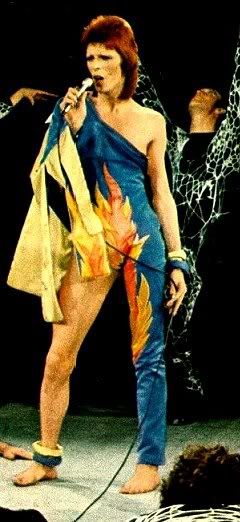
It’s easy to draw parallels from Gaga to other pop stars such as David Bowie, Madonna, and the late King of Pop. Indeed, Lady herself connects those dots. Some could even claim that she a a gothic Christina Aguilera of the era when she was singing songs like “Fighter” and making music videos of boys’ kissing. Despite Lady’s professions of raw originality, however, her image is merely a glossy amalgam of her own pop idols. Outrageous fashions and the quirky appeal to the marginalized of early Ziggy-era Bowie, unabashed bad-girl sexuality and proto-feminism of Madonna, and the slick production, coordinated dance moves, and seamless choreography of MJ, are all fused together in a girl who can actually sing, produced by people who are thoroughly schooled in pop psychology, and dispensed to the masses radio single after radio single. A grueling tour of live shows, in themselves grandiose productions not un-derserving of a Tony Award, support her recent album, The Fame Monster. She proudly proclaims that she lives for the show, that she revels in the glitter and drama and sound of it.

For Lady Gaga, fashion and music are one and the same. She has said that she writes songs based on an image of an outfit she has in her head; her songs are an excuse to wear something outrageous on stage. Each of her music videos feature her in no less than five outfits, and her taste in dress ranges from avant-garde pop diva to back alley prostitute to haute couture fashion model. Nothing is off limits, from a faux-nostalgic 1950’s dress to her monster ball outfit evoking the image on anime princess, or even a bra that spits sparks, if it fits her vision for art, she wears it. Makeup, outfit, props; the whole shebang is planned and executed in style.

While this is all grand and exciting, I can’t help but wonder what the overarching goal is. Especially in light of her newest single, “Bad Romance,” I have an uneasy feeling about where her career is headed. There is an inherent danger in living just for the show and soaking up the pleasures of a hedonic lifestyle; if you go and paint the town red, you will eventually run out of paint. As much as Gaga admires Bowie and his artistry, Bowie now is a far cry from the Bowie of the Ziggy, Thin White Duke, or “Let’s Dance” fame. He ran out of steam by the eighties and nearly crashed, resulting in him toning down his pop star image. If Lady Gaga thinks she can have all of the fun and none of the consequences, she needs to think again, because as it stands now, I see three possible directions that her career could go.

First, and least interesting, is that, despite her claims, that she is merely a cultivated pop icon whose script is written by record labels, no different from Ms. Spears. This would be incredibly disappointing for her fanbase, and detract a great deal from her ‘raw’ image.

Much more interesting and, in my opinion, necessary for the survival of her music career, is if Ms. Germanotta played Lady Gaga like Bowie played Ziggy; a pop act, no doubt, but an act that arrived, gained fame, and then left. Ziggy was a monstrous success - one that would probably have destroyed Bowie’s career should he have continued to play him. Bowie no doubt lost some fans because of the move, as would Ms. Stefani, but considering the alternative, I think it would be a wise move.

Equally interesting but decidedly hopeless is the possibility that Lady Gaga is all there is. I say ‘hopeless’ because, as I see it, her current persona - exemplified by the lyrics of (celebrating an emotionally parasitical and mentally unstable relationships) and accompanying video to “Bad Romance” - as unsustainable. That video (and other videos like it) is not the work of someone who is opening up new creative avenues; it is the aestheticization of a pop star’s destruction. Lady Gaga got the fame she wanted - the question is how long can she hold onto it? And if she does hold onto it, in which new, exciting direction will she take it?


_DZ


submit to reddit

1.12.2010

If you understand this sentence, sasuga

A recent blog post by jibtv blogger Anna Kunnecke got me thinking about uniquely Japanese words. Her deconstruction of the word bimyou highlights what is so hard about the Japanese language - that is is full of words that represent abstract ideas. Bimyou is definable, but depending on the context will mean different things. Anna has already written about that word, so I will turn my attention to a different word: sasuga.

Sasuga is one of those words that Japanese ex-pats love to drop when talking with other ex-pats. (One of them even uses it as a clever title for his blog.) It can be an adjective or an adverb, and is defined something along the lines of “clever, adept, good, expectations, as one would expect.” Example dialog: “Did you just see what Gary did!? He climbed that 50-foot fence using only his arms!” “Ooh! Sasuga Gary!”

This use of sasuga would be appropriate if Gary had a penchant for climbing things with only his arms, but had never attempted something as tall as 50 feet. You would expect Gary to top his old record.

Sasuga also carries the connotation that you would not expect anything less of a person, and in this context can be used to create a humorous situation out of a decidedly maladroit action. If you already expected someone to screw up, uttering a sarcastic "Sasuga!" when they do something like this is appropriate.

It’s this dichotomy that makes sasuga a joy to utter and a bane to hear, because the the word can either be praising or belittling, with no audible difference in intonation. You just don’t know. You don’t know if your friend is praising you or veiledly saying, “Surprise surprise, you lived up to what we thought you could do.”

In this way sasuga is brothers (or sisters, if you prefer) with the term atarimae, which means ‘expected’, ‘reasonable’ or ‘blatantly obvious.’ In Tokyo, for instance, it is atarimae that the trains run on time. Knowing the connotations of atarimae is extremely helpful, because if someone does something that is atarimae only to receive a reply of “sasuga,” then it is likely a sarcastic comment.

All this to say that when a foreigner new to the country hears the phrase “sasuga gaijin(foreigner),” they have no way of knowing whether or not it is a complement, because they have not yet learned what is atarimae and what is not. It’s one of those things you have to, as Anna says, take as a quicksilver-kind of word and go with the flow until you can determine the context. And if you figure out the context more quickly than your other gaijin friends, then I have one thing to say.

Sasuga!


_DZ


Dann writes from his home in snowy Minnesota, where sasuga is the correct response to -15F weather.


submit to reddit